San Francisco Silent Film Festival 2026
Share
Now that the century-old Castro Theatre has completed its two-year, $41 million restoration, the San Francisco Silent Film Festival returns on Wednesday to where it all began in 1996. Anita Monga, the artistic director of the nation’s largest silent film festival, tells K. D. Davis in the San Francisco Chronicle that the refurbished movie palace is “exquisite” and “as beautiful as it was in 1922, but with top-notch projection, sound, and better sight lines.”
Discussing this year’s program, the Chronicle’s G. Allen Johnson and Tony Bravo naturally begin with the opening night film—Erich von Stroheim’s Queen Kelly (1929), starring Gloria Swanson—and it isn’t long before they bring up Pamela Hutchinson’s new book, The Curse of Queen Kelly. “The behind-the-scenes story, which Hutchinson tells in such rich detail, is as bonkers as the film itself,” says Bravo. “That says a lot—‘Von,’ as he liked to be known, was a mad genius at the height of his artistic lunacy. By the late 1920s, Swanson reached the zenith of her fame and creative ambitions. She was the Taylor Swift of her day, and she was looking for a new era.”
She found a whole lot more than she was after in the role of a convent girl who winds up running a brothel in Africa. Von Stroheim’s extravagance, financial and otherwise, led Swanson to convince producer Joseph P. Kennedy to pull the plug on the production. “A bastardized version was released abroad, leading to decades of wondering what might have been,” writes Nicolas Rapold in the New York Times. “Queen Kelly now returns in what Milestone Films calls ‘an improved reimagining’ that draws on nitrate prints, outtakes, stills, and more (after a previous reconstruction in 1985). The shimmering, sensitively scored restoration brings out the production’s opulence and hence the regal stage von Stroheim sets for his characters’ attractions and abjection.”
“Virtually every beat in the plot would have, given the chance, gotten the film banned in the U.S. for decades to come,” writes Michael Atkinson for Screen Slate. “Of course, the money is all on the screen—von Stroheim knew how to gild the lily and fill the frame—and, as the hot bulb of silent stardom at the movie’s center, Swanson was gorgeous in a witchy way movies haven’t seen much since. Her weird diva presence rhymes perfectly with the director’s wild excesses; in fact, as an autumnal artifact from the fading days of roaring ’20s libertinism, just as talkies took over and the Depression began, Queen Kelly ultimately makes a hot-to-handle case for von Stroheim being his era’s formative and most subversive constructor of camp.”
New York Times critic Wesley Morris will introduce Wednesday’s screening, and Eli Denson, who composed the new score, will conduct the San Francisco Conservatory of Music Orchestra.
Thursday
The first full day of the festival begins with a preservation showcase featuring clips, short films, and presentations from around the world. The Danish Film Institute’s Thomas Christensen will then introduce Urban Gad’s The Abyss (1910), starring Asta Nielsen, and A. W. Sandberg’s The Clown (1917), in which matinee idol Valdemar Psilander gave his final performance.
Paul Richter, whose work with Fritz Lang had turned him into a sex symbol of the Roaring Twenties, stars in Gennaro Righelli’s Sensation im Wintergarten (1929) as a count who runs off to join the circus and becomes a world-famous trapeze artist. Directed by William deMille—whose younger brother, Cecil B., capitalized the D in the family name and added quite a lot of cultural clout to it—Miss Lulu Bett (1921) stars Lois Wilson as a put-upon woman who frees herself from enslavement in the home of her half-sister to start a new life with the man she loves. Adapted from Zona Gale’s Pulitzer Prize–winning play, Miss Lulu Bett entered the National Film Registry in 2001.
Friday
Set in the mid-twentieth century—a future teetering on the brink of a war between the United States of Europe and the Empire of the Atlantic States—Maurice Elvey’s High Treason (1929) is, as David Cairns has put it in a piece for Notebook, “Britain’s answer to Metropolis.” The White Trail (1932), directed by skier and photographer Adam Krzeptowski, follows, and writing for the Pordenone Silent Film Festival in 2022, Michał Pieńkowski noted that the story may be thin, but the film, which premiered at the very first Venice Film Festival, looks spectacular.
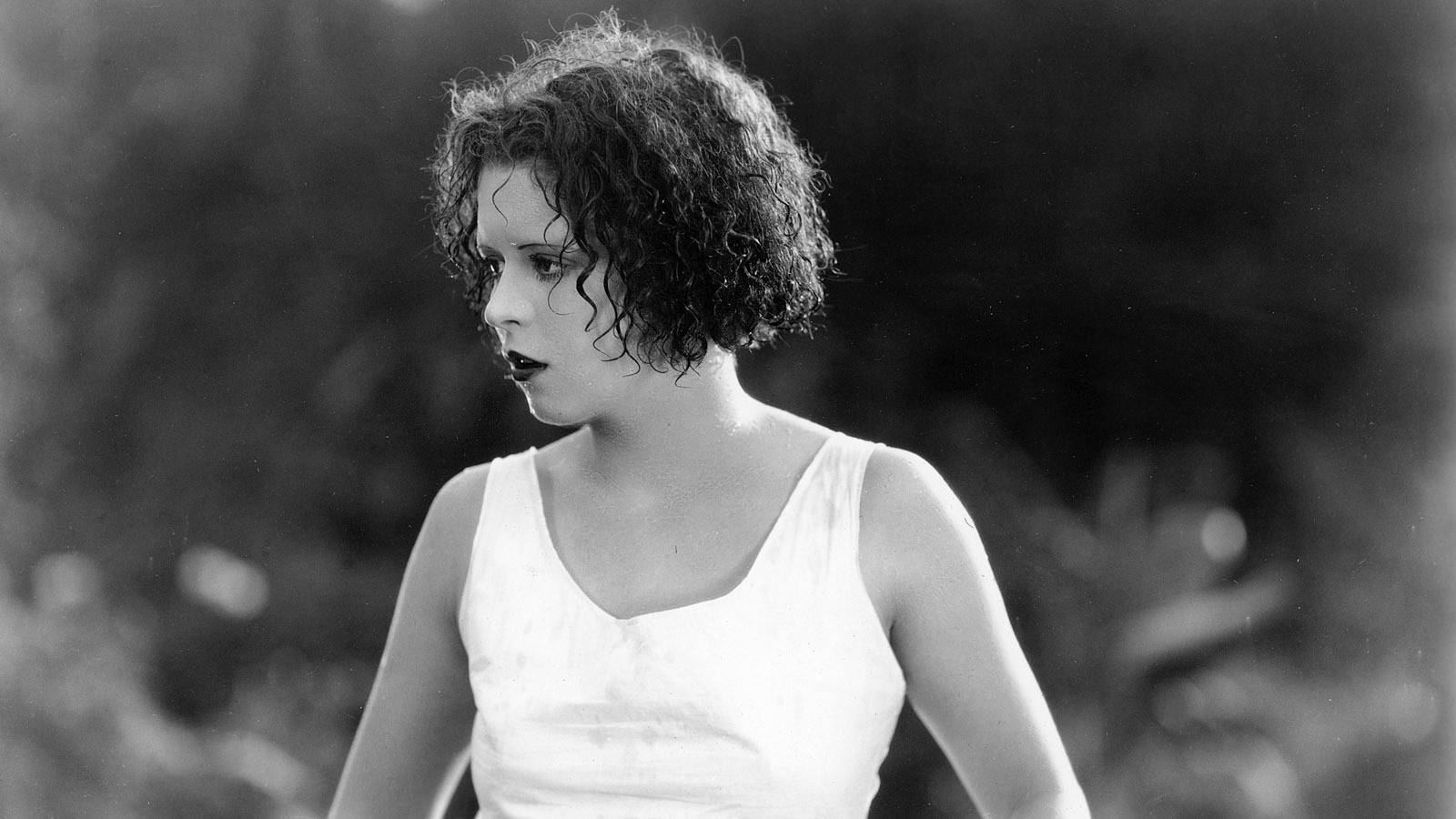
Friday afternoon brings Clara Bow in Hula (1927). When David Stenn, the author of Clara Bow: Runnin’ Wild, introduced the premiere of the new restoration at the Museum of Modern Art in January, he noted that Bow “cemented her ‘It’ Girl reputation with this smash-hit sex comedy from ex-Bow beau Victor Fleming, the future director of both The Wizard of Oz and Gone with the Wind. Fleming’s Paramount studio-mandated task in Hula was to showcase Bow’s phenomenal screen presence despite the flimsiest of plots.” Bow’s Hula Calhoun is growing up on a pineapple plantation in Hawaii when she falls for a married man. “The whole thing is pretty much an excuse to get Clara into grass skirts and wet frocks,” writes Fritzi Kramer, “but she sells it.”
A program of kami firumu—Japanese films from the 1930s made on paper rather than celluloid—follows. The Japanese Paper Film Project has digitally rescued more than two hundred of them. “There is something uncanny about watching the visibly worn sprocket holes, abstract dirt marks and stains, and folded creases that appear and disappear on the paper as the animations play,” writes Shelby Shaw for Screen Slate. “Rather than distract from the content, they magnify the sense that the paper itself is coming to life as it rapidly changes on-screen right before viewers’ eyes; meanwhile, the printed characters in the images seem not to take any notice of what mortality surrounds them.”
Marie Prevost was coming off of three films directed by Ernst Lubitsch when she starred in Lewis Milestone’s The Caveman (1926) as a bored heiress who decides to introduce a coal heaver (Matt Moore) to high society and pass him off as a professor. Future gossip columnist Hedda Hopper appears in a supporting role and a young Myrna Loy plays a maid.
Friday wraps with Tabu: A Story of the South Seas (1931), the last film directed by F. W. Murnau, who died at forty-two in a car crash just one week before the film’s premiere. “The story is simple to the point of universality,” writes Jake Cole at Slant. “It’s a Romeo and Juliet narrative framed through the prism of island life, with Reri’s (Anne Chevalier) virginity placed under total protection by tribe elders to preserve her sanctity for the gods, much to the chagrin of her love interest (Matahi). The pair flees this repressive system only to find themselves, unluckily, in a Murnau film, with all its attendant focus on the corrupting influences of material greed.”
Saturday
Saturday offers four Laurel and Hardy shorts introduced by Serge Bromberg, a pre–Queen Kelly Gloria Swanson as a Parisian gangster in Sidney Olcott’s The Humming Bird (1924), and Ryszard Ordynski’s Janko the Musician (1930), an adaptation of an 1879 story by Henryk Sienkiewicz, who won the Nobel Prize for Literature in 1905. When Pamela Hutchinson saw Janko in Pordenone in 2016, she was “utterly besotted,” calling it “a very poignant film, with easy charm and visual lyricism.”
When Light Industry screened Abram Room’s Bed and Sofa (1927) in 2013, the venue pulled a quote from Amos Vogel’s Film as a Subversive Art (1974): “A masterpiece of psychological realism, its sexual triangle (caused by the postrevolutionary housing shortage) involved husband and lover changing places on bed and sofa, until the pregnant woman, tired of male chauvinism, decides to leave them both. The film is unique in its emphasis on the individual rather than class and its portrayal of unconventional sexual mores in early Soviet Russia; it reflects, in its anti-puritanical humanism, the atmosphere of the early revolutionary days far more accurately than some of the large-scale propagandist works of the period.”
His Greatest Bluff (1927) is a comedy driven by the search for stolen jewels and the identity switcheroos pulled off by twins played by director Harry Piel, but it is probably best known for featuring Marlene Dietrich in one of her earliest roles. Saturday then bows out with two French city symphonies. In 2011, Robert Polito wrote that with À propos de Nice (1930), Jean Vigo and Boris Kaufman “discovered subtle and persuasive cinematic strategies to render the fantastic as if it were the everyday, and the everyday as though it comprised a vision of the end of the world.”
Two years ago, MoMA programmers noted that Alberto Cavalcanti’s Rien que les heures (1926) “did for Paris what Paul Strand and Charles Sheeler’s Manahatta did in 1921 for New York: burnish the romance of the new metropolis in our collective subconscious, tracing in a melodic arc from dawn to dusk to dawn the intricate choreographies of the man in the crowd and machines in concert with nature; the rhythms of rain and regulated time; the abstract geometries of pattern and movement and shadow.”
Sunday
It’s heavy hitters from morning until night on the final day of the festival, beginning with William Wyler’s 1927 western Blazing Days. J. Hoberman has called Ernst Lubitsch’s So This Is Paris (1926) “a good-natured send-up of sheikhs, jazz babies, and would-be wife swappers, replete with binge drinking, outrageous Freudian symbolism, and a writhing kaleidoscope that must be the ultimate Charleston scene.”
In Love One Another (1922), a young Jewish woman leaves her village for St. Petersburg, where she falls for a revolutionary eager to help overthrow the tsar. “A multiplicity of plot strands, life in the shtetl, and espionage in the city, Carl Theodor Dreyer pulls them together in a brutal crescendo,” writes Fernando F. Croce.
Writing for Screen Slate, Jonathan Mackris is “inclined to say” that Marie Harder’s Bookkeeper Kremke (1930) is “the true hidden gem of the entire festival. Harder’s career, lasting just under two years and comprising just two films, is a bit enigmatic. She’s almost certainly the first woman director in Germany to complete a feature film, made in her capacity as the head of the film department of the German Social Democratic Party.” Bookkeeper Kremke is “mostly built around dramatic sequences detailing the crisis of the German middle class as millions were put out of work during the Great Depression. Interspersed throughout are snippets of reportage decrying automation and depicting worker protests, complimenting and commenting on what is otherwise a straightforward kammerspiel drama.”
SFSFF 2026 closes out with one of the greatest films of any era, King Vidor’s The Crowd (1928). Vidor “could call his own shots after 1925’s war epic The Big Parade, the highest-grossing film of the entire silent period,” notes Dennis Harvey at 48 Hills. “That vast canvas whetted his appetite for a story about the ‘little people,’ ordinary working Joes and Janes. He cast unknown James Murray and moderately-known Eleanor Boardman (who happened to be Mrs. Vidor) as two likable if nondescript New Yorkers whose love weathers various travails. If these lives are deliberately writ ‘small,’ devoid of standard glamour, Vidor’s treatment nonetheless is a showcase for both location shooting and studio-bound stylistic wizardry—The Crowd is rightly considered one of the crowning artistic achievements of Hollywood’s pre-talkie epoch.”
Don’t miss out on your Daily briefing! Subscribe to the RSS feed.