Four by Sophie Letourneur
Share
“I don’t situate myself or my work in bourgeois cinema or literary cinema, or these bourgeois conventions or codes,” Sophie Letourneur tells Helen Fortescue-Poole at Screen Slate. “In fact, I really like a mix of triviality and poetry, comedy and melancholy. Above all, I really don’t want to make snobbish cinema.”
Through May 26, L’Alliance New York is screening one of Letourneur’s features each Tuesday, and the series opened last month with L’aventura, which made Cahiers du cinéma’s list of the top ten films of 2025. As Letourneur told Giovanni Marchini Camia in BOMB in 2012, La vie au ranch (Chicks, 2009), screening tomorrow, is partly inspired by a time in her life when she extracted herself from a tight group of friends. Letourneur described the great lengths she went to in order to find her cast of nonprofessional actors before embedding herself with the group, often recording hours of improvised scenes that she would then winnow down to just a few minutes of screen time.
The result is a “raunchy dramedy about twentysomething hipsterettes,” as David Fear described La vie au ranch in Time Out. “It’s the filmmaker’s willingness to let these uncouth females un-self-consciously get drunk, piss in the streets, and talk like sailors that supplies La vie’s true emotional nakedness. All the narrative formlessness—ladies get shit-faced, fret over guys, don’t rinse, repeat—and extended scenes of little besides salty conversations might fool viewers into thinking that nothing happens. But as the characters gradually realize that their wild-child idyll can’t last, you see that Letourneur understands the impact of going out on a whimper.”
Letourneur’s 2011 short Le marin masqué won a prize that came with a tidy little sum, 30,000 euros. Locarno then invited Letourneur and her short, so she decided to spend her prize money on a feature she would shoot at the festival with two of her friends.
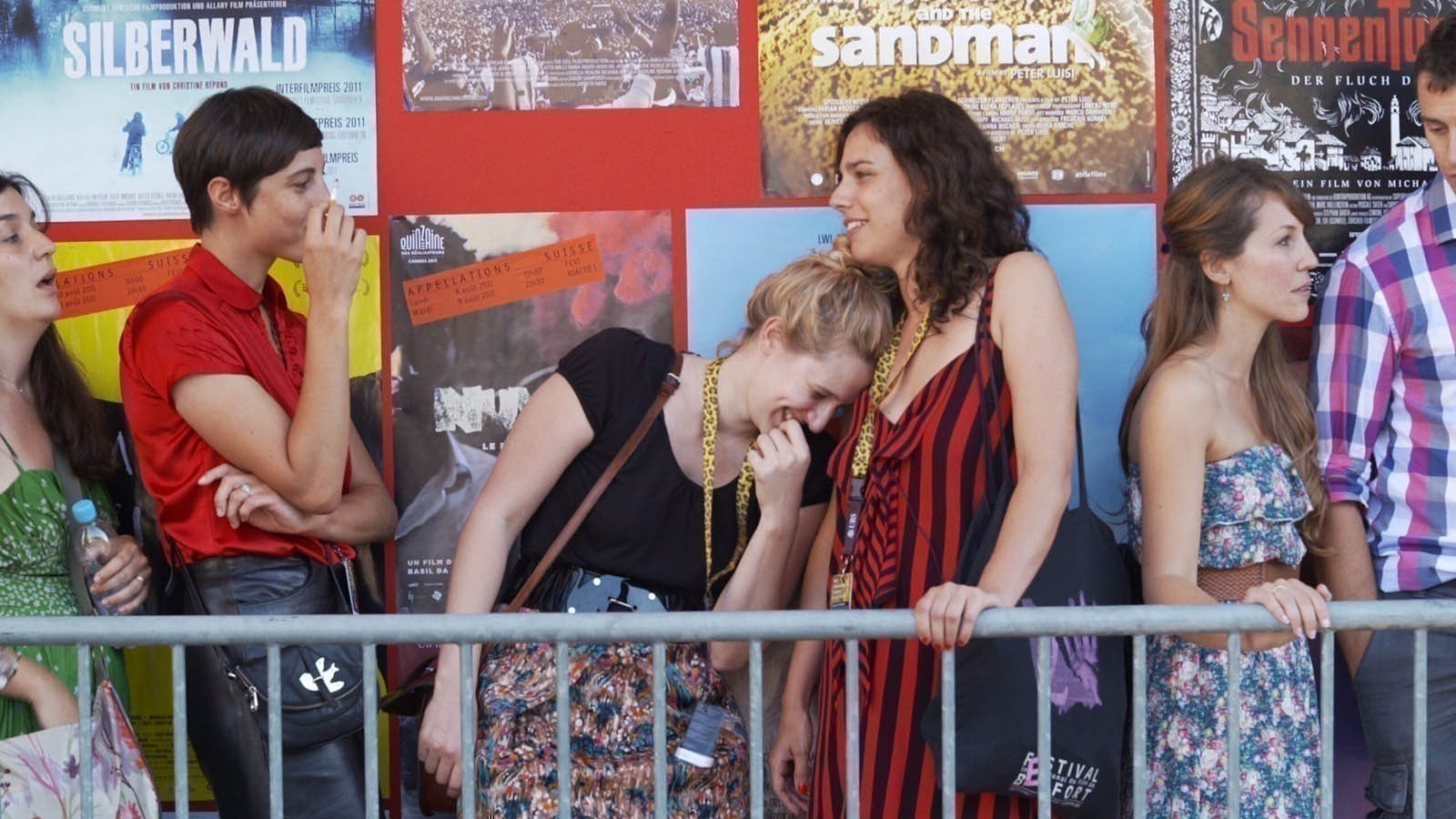
In Les coquillettes (2012), “Letourneur’s fictionalized version of herself is more interested in stalking Louis Garrel than she is in the screening of her own film,” noted Emma Myers at the top of her interview with the director for Film Comment. “Her two gal pals—the capricious Camille [production assistant Camille Genaud] and ultra-cool Carole [editor Carole Le Page]—are similarly man-crazy, immersing themselves in a whirlwind of parties hoping to score. Framed by the postmortem meeting of the girls back in a Parisian flat, the film derives its humor from the disjunction between the way they recount (and embellish) the events of the festival and the way we see them unfolding.”
Les coquillettes is another of Letourneur’s “seemingly improvised yet intricately written dramedies,” wrote Jordan Mintzer in the Hollywood Reporter. “Drawing inspiration from the likes of Eric Rohmer, John Cassavetes, and Hong Sangsoo, yet managing to find her own voice, she has a real knack for depicting the je ne sais quoi adventures of French chicks getting off on their friendships, while never quite getting it on with their male counterparts.” Letourneur told Myers that she’d originally intended to shoot Les coquillettes at Cannes, but now, she tells Fortescue-Poole, she’s considering an adaptation set at SXSW.
Lolita Chammah has appeared in dozens of features, and in two of them, she’s played the daughter of characters portrayed by Isabelle Huppert, which is fine casting, considering that she is, in fact, the daughter of Huppert and writer, producer, and director Ronald Chammah. Letourneur cast Lolita Chammah in Gaby Baby Doll (2014) as a woman recovering from a nervous breakdown. She can’t stand to be alone, but her boyfriend has abandoned her in a remote country house. Gaby eventually finds her way to Nicolas, played by Benjamin Biolay, a singer, songwriter, and occasional actor who has worked as an arranger or producer with Juliette Gréco, Françoise Hardy, and Vanessa Paradis.
Gaby Baby Doll is a “subtly frantic romantic comedy,” writes the New Yorker’s Richard Brody, “both a sentimental delight and a cinematic equation: add a budget, a script, and stars to a director of homemade, improvised, personal movies.” Nicolas, “a hirsute hermit, is as unfit for company as Gaby is for solitude; Letourneur pulls off the predestined magic with a light and giddy touch.”
Enormous (2019), the winner of the Prix Jean Vigo, stars Marina Foïs and Jonathan Cohen as Claire and Fred, a married couple who have agreed that neither of their lives has room for kids. But then Fred changes his mind and insidiously arranges to impregnate his wife. “Pregnancy can be everything all at once,” Letourneur tells Fortescue-Poole. “It can be beautiful, it can be monstrous, it can be unbearable . . . I realized that in order to do everything I wanted to do, I would have to make things even stranger.”
Richard Brody notes that much of Enormous “involves the couple’s consultations with doctors, midwives, and other professionals (real-life ones, filmed on site); much of the comedy comes from Fred’s outsized enthusiasm for his impending fatherhood (Cohen, a popular comedian in France, riffs wildly throughout). The movie confronts Fred’s domineering cruelty, yet Claire’s conflicts (keenly displayed in Foïs’s withdrawn bewilderment) get short dramatic shrift, replaced by antic physical and sexual comedy that nonetheless suggests the irrational bonds of love.”
Don’t miss out on your Daily briefing! Subscribe to the RSS feed.