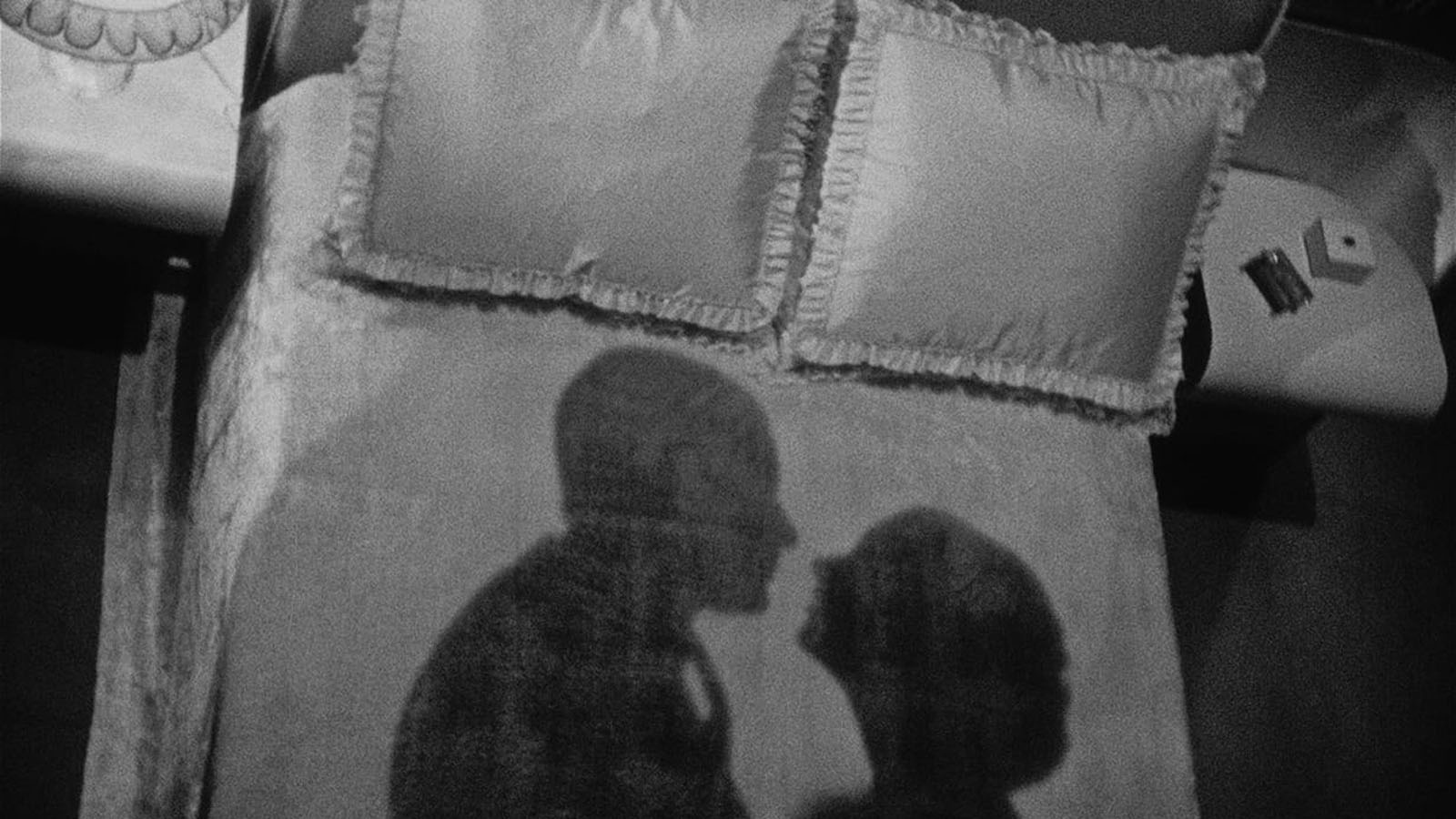
The 2026 version of The Lubitsch Touch isn’t quite as expansive as the one New York’s Film Forum presented in 2017, but it is certainly just as welcome. Writing in the Village Voice nine years ago, Farran Smith Nehme noted that “the Lubitsch touch” was “the brainchild of a go-getter in the Warner Bros. publicity department named Hal Wallis, when Ernst Lubitsch was under contract at the studio in the 1920s. Thus did future producer Wallis invent one of the few PR slogans ever to be turned by critics into a philosophical debate, to be defined and redefined ever since. On the simplest level, I’d agree with Armond White that the touch was sophistication. You may favor a mistier, more metaphysical definition,” but “we all know the touch when we see it.”
“The phrase hovers over the filmmaker like a halo,” wrote Siri Hustvedt in her 2019 essay on Lubitsch’s final completed feature, Cluny Brown (1947). “It appears to be a quality of visual and verbal grace that cannot be reduced to any particular aspect of production. As far as I can tell, no writer has mentioned that, whatever it means, it summons the tactile sense, what is never present for any moviegoer except by imagination. Lubitsch loved to evoke that missing sensual element by suggestion—especially the play and pleasure of human sexuality.”
An Ashkenazi Jewish Berliner, Lubitsch was nineteen when he began performing with Max Reinhardt’s Deutsches Theater, and within a few years, he was directing and starring in short comedies. By the late 1910s, he was directing such stars as Pola Negri and Emil Jannings in feature-length historical dramas. They were hits, and in 1922, he set out for Hollywood, where he would establish his reputation as a master of urbane comedy.
In a 2017 essay for the New York Review of Books,Geoffrey O’Brien wrote that Lubitsch “offers a parallel domain of buoyant elegance, a theater of free-floating desire and inextinguishable humor ingeniously stitched together out of the fabric of Austrian operettas and French farces and the plot devices of a hundred forgotten Hungarian plays, flavored by delicate irony and risqué innuendo, where sex is everywhere but just out of sight behind discreetly closed doors, constantly implied in what is never quite stated.”
Starting tomorrow, this year’s series of thirteen features will run on Tuesdays through June 30 and open with The Love Parade (1929). Set in Sylvania, a make-believe country somewhere in Central Europe, Lubitsch’s first sound film stars Maurice Chevalier and Jeanette MacDonald as a count and a queen with the hots for each other. The Love Parade “depicts the battle of the sexes waged with lacerating, loose tongues, as would become his trademark,” wrote Michael Koresky in his 2008 overview of four Lubitsch musicals, all of them screening at Film Forum. “These were the days before enforcement of the moralizing Production Code (colloquially known as the Hays code), so in this and his other early sound musicals, Lubitsch could be even more wicked.”
MacDonald costars with Jack Buchanan in Monte Carlo (1930), a musical “pungent with sexual overtones,” while the “infectiously giddy” The Smiling Lieutenant (1931) features Chevalier torn between Franzi (Claudette Colbert), the leader of an all-girl orchestra, and Anna, the Princess of Flausenthurm. Chevalier and MacDonald are reunited in One Hour with You (1932), playing Andre and Colette, a couple whose happy marriage is challenged when Colette’s best friend, Mitzi (Genevieve Tobin), makes a move on Andre. When One Hour With You premiered in New York, the Times’s Mordaunt Hall reported that there were “moments when the audience giggled in expectation, and other incidents aroused hearty mirth.”
Just seven months after that night, Trouble in Paradise (1932) thrilled Hall to new exclamatory heights: “Imagine the charming Miriam Hopkins impersonating an ingratiating, capable thief! Then try to visualize Herbert Marshall as a delightful scoundrel who might look upon Alias Jimmy Valentine as a posing blunderer!” Hopkins’s Lily and Marshall’s Gaston team up to relieve Madame Mariette Colet (Kay Francis) of her diamond-encrusted purse, but then Gaston finds himself taking a little more than a liking to their target. Lubitsch himself once said of Trouble in Paradise: “For pure style, I have done nothing better or as good.”
Design for Living (1933) is “what sexy should be—delightful, romantic, agonizing ecstasy,” wrote Kim Morgan in 2011. “And it’s not just sexy but also revolutionary, daring, sweet, sour, cynical, carefree, poignant, and so far ahead of its time that one could cite it as not only a pre-Code masterpiece but also a prefeminist testimonial. A uniquely Lubitschian picture in its elegance and graceful wisdom, with the gruffly intelligent, street-smart Hollywood writer and soon-to-be legend Ben Hecht collaborating, this take on the trials, titillations, and torments of a kind of relationship usually seen in true adult films, a ménage à trois (and one involving the gorgeous trio of Fredric March, Gary Cooper, and Miriam Hopkins), is unlike any other movie of its era.”
The four early musicals, Trouble in Paradise, and Design for Living were all made for Paramount, but in 1934, MGM reunited Lubitsch, Maurice Chevalier, and Jeanette MacDonald for a third adaptation of Franz Lehár’s 1905 operetta The Merry Widow (the first was directed by Michael Curtiz in 1918 and the second by Erich von Stroheim in 1925). This would be the “last and finest” of Lubitsch’s musicals, noted Dave Kehr in the Chicago Reader in 1985, and the director “brilliantly exploits Cedric Gibbons’s opulent sets, but his genius is most evident in the film’s final poignancy—a farewell to the genre he helped to create.”
Before working together on the screenplays for such enduring classics as Ninotchka (1939), Ball of Fire (1941), and Sunset Boulevard (1950), Billy Wilder and Charles Brackett teamed up for the first time to write Bluebeard’s Eighth Wife (1938). Gary Cooper stars as a filthy rich American who meets his #8 (Claudette Colbert) on the French Riviera. “Lubitsch has rarely come so close to zaniness, to the wackiness celebrated by the Marx brothers,” wrote Serge Daney in Cahiers du cinéma in 1968.
In Ninotchka, Greta Garbo’s stern Leninist is sent by the Soviets on a strictly-business trip to Paris, where she will eventually fall in love with a count (Melvyn Douglas) and, famously, learn to laugh. Talking to James Linville in the Paris Review in 1996, Wilder recalled how he and Brackett got stuck trying to figure out a way to depict Ninotchka’s conversion. Lubitsch called them over to his place.
“It’s funny,” said Wilder, “but we noticed that whenever he came up with an idea, I mean a really great idea, it was after he came out of the can. I started to suspect that he had a little ghostwriter in the bowl of the toilet there. ‘I’ve got the answer,’ he said. ‘It’s the hat.’” Ninotchka has scoffed at a ridiculous hat she’s spotted in a storefront window, but later, on her own in her room at the Ritz, she opens a drawer, pulls out that very same hat, “puts it on,” Wilder went on, and “looks at herself in the mirror. That’s it. Not a word. Nothing. But she has fallen into the trap of capitalism, and we know where we’re going from there.”
The only Lubitsch film to feature either Margaret Sullavan or James Stewart, The Shop Around the Corner (1940) gives us both actors. They star as Klara and Kralik, clerks in a leather goods store in Budapest. They can’t stand each other, and besides, each of them has been fanning flames with a secret pen pal. “There’s such sweet inevitability to Klara and Kralik’s love story,” writes the Austin Chronicle’s Kimberley Jones. “That doesn’t mean the movie is all softness; Lubitsch gooses laughs from an adulterous affair and a suicide attempt, after all. The real surprise is in how earnestly the director of some of the finest, spikiest romantic comedies ever made is willing to step off the gas and let heartfelt romance win the day. And it is so very winning.”
In 1942, a comedy about a troupe of Polish actors attempting to outsmart the Nazis occupying Warsaw was a risky proposition, and early reviews of To Be or Not to Be were mixed. But the film “did something rare,” wrote Geoffrey O’Brien in 2013, “by interweaving farce and disaster in such a rigorously structured fashion as to elicit, in the very same scenes, genuine anxiety and a hilarity so acute that it has something like an ecstatic kick. For many, myself included, it is close to being the funniest film ever made, featuring Carole Lombard in her last and greatest performance and Jack Benny in the only film role that did justice to his comic genius. But at every step, it keeps plainly in view—just offscreen, and detectable even in the comic buffoonishness of Sig Ruman’s Colonel Ehrhardt—the possibility of real terror, real soul-destroying cruelty, real suffering.”
In Heaven Can Wait (1943), Henry (Don Ameche) passes away on the day after his seventieth birthday and appears before His Excellency, as polite a top-tier demon as anyone might expect in a Lubitsch film. Arguing that he belongs in Hell, Henry launches a series of flashbacks. “Heaven Can Wait is possibly the director’s most downbeat film, darker in some respects to even To Be or Not to Be,” wrote Jake Cole at Slant in 2018. “But Lubitsch consistently finds ways to alleviate serious moments of romantic longing and feelings of betrayal . . . The entire ethos of the film, if not a sizable portion of Lubitsch’s oeuvre, is summed up by an early line that Henry tells His Excellency when the latter asks if he had a good funeral: ‘Well, there was a lot of crying, so I believe everybody had a good time.’”
Don’t miss out on your Daily briefing! Subscribe to the RSS feed.