Lucrecia Martel at Berkeley
Share
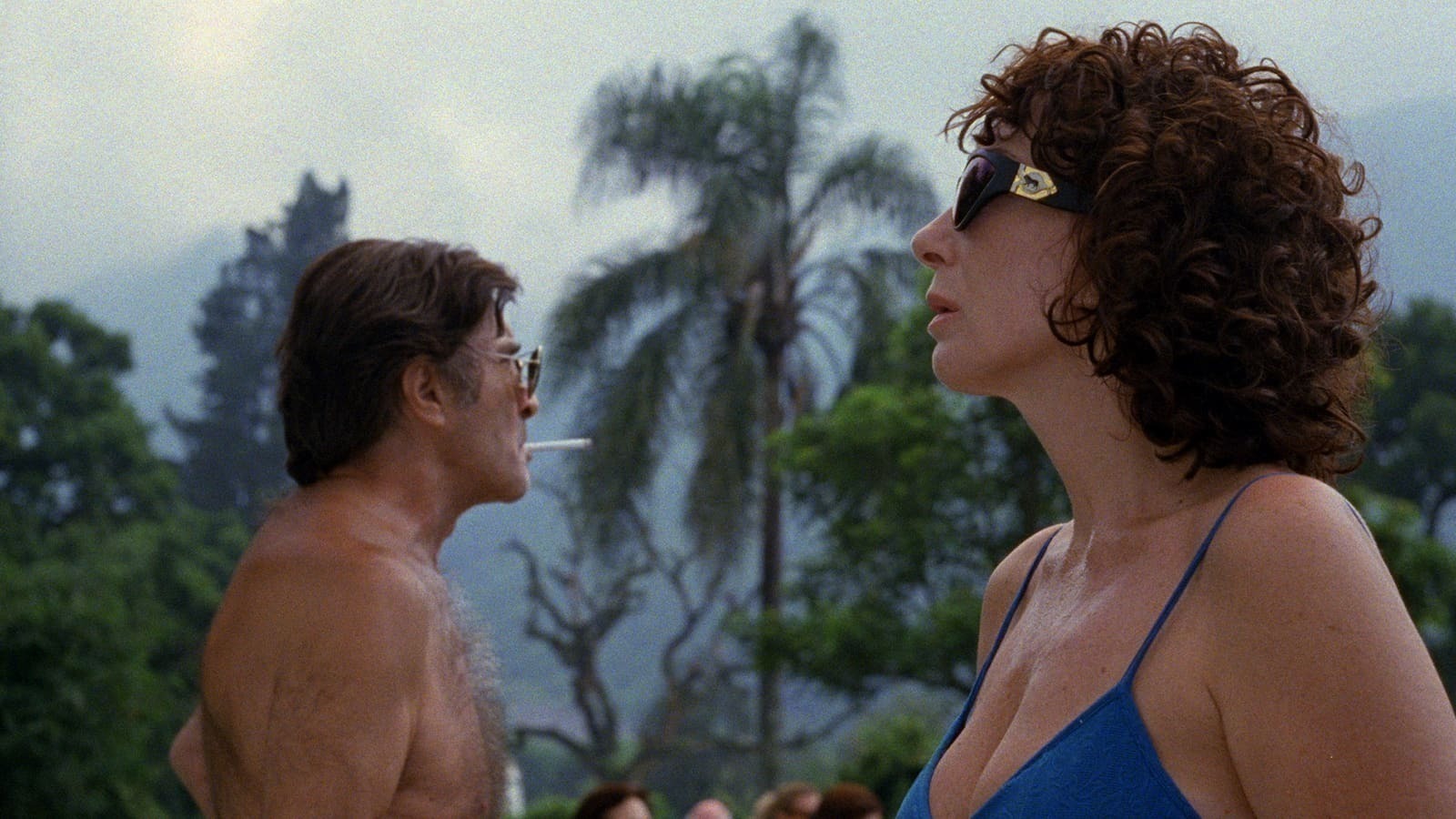
“If the world is so complicated, why don’t we harness the power of cinema to reshape perception?” asks Lucrecia Martel at one point in her conversation with Andrea Avidad at Screen Slate. “If we were all living in a wonderland with jobs, access to education, and healthcare, it would truly be foolish to alter people’s perceptions. But that’s not the reality we’re in. We live in a world of uncertainty and fear. We cannot put off rethinking our ways of thinking, our habits, and our ideas.”
On Saturday, the Berkeley Art Museum and Pacific Film Archive will launch Lucrecia Martel: Un destino común—a retrospective presented in conjunction with the filmmaker’s residency at UC Berkeley—with the presentation of a 35 mm print of Martel’s debut feature, La Ciénaga (2001). The title—The Swamp—is the fictional name Martel has given Salta, the capital of the northern province of Argentina that bears its name and her own hometown. The film, a discursive group portrait of a large family summering at their country estate, tells no single story but instead maintains an elastic tension, a constant and apprehensive sense that something—and probably not something good—is just about to happen.
“It is difficult to tell what is central and what is secondary in each image, as the story avoids emphasizing any one situation over another,” wrote David Oubiña in his 2015 essay on La Ciénaga. “But that is precisely what is so distinctive about this stunning movie. Promiscuity, confusion, uncertainty: what the film relates is contained in the way it relates it.” La Ciénaga is “precisely a movie about unproductive pursuits, wasted time, the dissipation of energy, inactivity. Its characters are stuck in a bog, and not one of them seems to notice they’re sinking without hope of rescue.”
In The Holy Girl (2004), a fourteen-year-old girl finds herself rubbed up against in an overtly sexual manner by a doctor attending a convention at the hotel owned by the girl’s mother. “Working against the grain of this potentially lurid story,” wrote J. Hoberman in the Village Voice, “Martel again builds her dryly comic drama from an accumulation of recurring riffs and seemingly unrelated micro-incidents. Complicated family relations are only gradually made clear; narrative lines do not rush to converge. Where La Ciénaga seemed steeped in a Chekhovian sluggishness, The Holy Girl is more concerned with transience. With its chance meetings and hectic confusion of public and private space, the hotel is the perfect setting; with her morbid confusion between sexual and spiritual excitement, the adolescent Amalia (Maria Alché) is the perfect heroine.”
The Headless Woman (2008) completed what became known retroactively as Martel’s Salta trilogy. Véro (Maria Onetto), a woman, clearly well-off—it’s the sunglasses, the earrings, her hair’s shade of blonde—is driving along a dirt road when her phone rings. She leans away from the steering wheel to pick it up and hits something. A dog? One of the Indigenous boys seen early playing along the roadside? Véro takes a moment to gather herself—and drives on. Some time will pass before she can pronounce out loud the conclusion she’s reached: “I killed someone on the road.” Her family and friends scramble to cover up what all of them assume to be a hit-and-run.
Writing about The Headless Woman for n+1 in 2010, Benjamin Kunkel gave readers a brief primer on the history and culture of Salta, discussed Martel as a standard-bearer of the New Argentine Cinema, and sorted through various readings of the film that critics had offered, both pro and con. “The richness and perturbation of the film derive, of course, not from any of these interpretations,” wrote Kunkel, “but from its way of sponsoring all of them while at the same time confining itself to the strictest realism. The Headless Woman is an astonishing movie about an overdetermined and, in that way, highly life-like and familiar situation—at once very local, global, social, and sexual—in which something has gone badly wrong, and the wrongness is compounded by your inability to say exactly what.”
Martel’s fourth feature, Zama (2017), didn’t arrive until nine years after the release of The Headless Woman, and another eight years would pass before her fifth, Landmarks (2025), premiered in Venice last summer. But throughout a filmmaking career that began in the late 1980s, Martel has made short films, and BAMPFA will screen a selection of six of them on April 18. Martel will be on hand to talk about them as well with Blanca Missé, an associate professor at San Francisco State University.
Based on Antonio di Benedetto’s 1956 novel, Zama stars Daniel Giménez Cacho as Don Diego de Zama, a magistrate stationed at a far-and-away South American outpost of the Spanish Empire in the waning years of the eighteenth century. Zama has put in a request for a transfer to Lerma, a town at the center of Salta, in order to be closer to his wife and children. He’s sure that transfer will be forthcoming, and so, he waits, year after year, suffering one humiliation after another.
In his 2018 review for Reverse Shot, Adam Nayman note that in “a superb, far-ranging interview with José Teodoro for Film Comment, Martel says that what interested her about Benedetto’s character was his inability to go with the flow: ‘If he surrendered his existence to his surroundings, he’d be much less dissatisfied.’ The comic irony of Zama is that a man who embodies the occupying mentality of colonialism is desperate to escape the very land that he’s appropriated.”
Martel has worked with sound designer Guido Berenblum on all of her features, and she tells Andrea Avidad that what she finds “interesting about sound is that it’s the realm of the untamed, where references aren’t so clear. That’s why all of this makes it comparable to desire, as well as to the undefined, the continuous, and the difficult to legislate.” 4Columns film editor Melissa Anderson has noted that Martel and Berenblum use the Shepard tone at least three times in Zama: “This sinister drone—an auditory illusion that gives the impression of a tone continually descending in pitch—sounds like the world ending, or madness corroding an already diseased soul. It is the sound of falling into an abyss.”
Landmarks, Martel’s first nonfiction feature, takes as its starting point the 2009 murder of Javier Chocobar, an activist and leader of Argentina’s Indigenous Chuschagasta community, and expands to cover the 2018 trial of the local landowner whose attempt to evict the Chuschagasta people from the hills he intended to mine led to the confrontation. The scope of Landmarks widens, “gradually building a damning account of five hundred years of dispossession and violence against indigenous citizens,” writes A. G. Sims for Reverse Shot. “Martel’s filmmaking here is intentionally straightforward and precise, wielding careful storytelling as a cudgel against the bludgeoning power of the state, in order to credibly represent and affirm the existence of a history and culture that has been ‘officially’ denied. It hardly seems like a concession considering what’s at stake.”
Talking earlier this year to Flavia Dima at Sabzian, Martel insisted that “I have never worried about style, not even in my fiction films. Style, to me, seems something stupid, something noticed mainly by those who know little about cinema. Style is not something one imposes on the world. It emerges only when one observes the world and, starting from the world itself, imagines an audiovisual order through which its story can be told. Style then appears, not as an intention, but as a consequence, as an effect.”
Diva notes that some critics have been put off by the use of drones in Landmarks. “I think one of the challenges for us, contemporaries, is what we do with technology,” says Martel. “Because it wasn’t necessarily invented for the well-being of citizens but rather for surveillance, control, or punishment. Our challenge, I believe, is to take this technology which was not created to serve people’s needs, but rather business interests or military purposes, and find ways to turn it around in the community’s favor. Generally, when you make a film about community problems, directors are naturally interested in engaging with people, having conversations, and so on. Yet, on that scale, it’s easy to lose sight of why those people are at risk. It’s because they live in such a beautiful place.”
Don’t miss out on your Daily briefing! Subscribe to the RSS feed.