March Books
Share
The return of Another Gaze brings not only the revival of an essential journal and its streaming platform, Another Screen, but also a special screening celebrating the latest release from Another Gaze Editions. First published in 1955 and appearing now in English for the first time, Yoshiko Shibaki’s Susaki Paradise is a collection of “six interlinked short stories revolving around the ramshackle Bar Chigusa and its no-nonsense landlady, Tokuko.”
Moeko Fujii has written the forward to the new translation by Polly Barton. The stories inspired both Kenji Mizoguchi’s Street of Shame (1956) and Yuzo Kawashima’s Suzaki Paradise: Red Light (1956), and the latter will screen at Japan Society in New York on April 17.
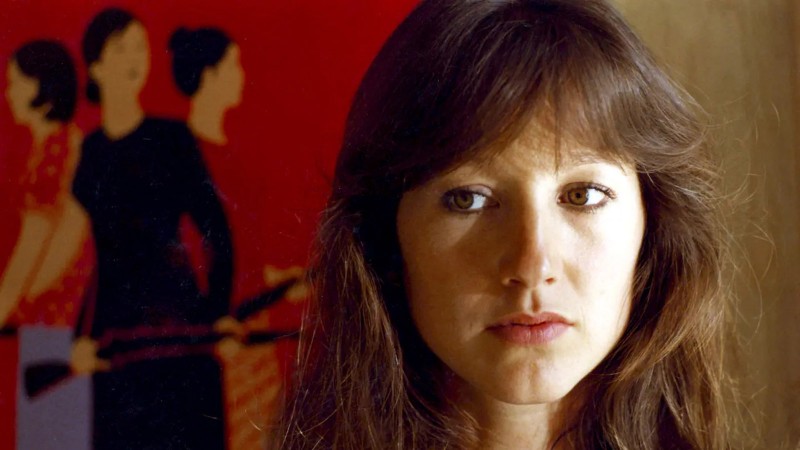
Another Gaze cofounding editor Daniella Shreir, in the meantime, has an outstanding essay on Chantal Akerman in the new London Review of Books. Occasioned by the 2024 publication of Oeuvre écrite et parlée, 1968–2015, a collection of Akerman’s varied writings edited by Cyril Béghin, Shreir’s rich survey is a biographical outline and a primer on the oeuvre that takes into account Akerman’s rejection of “identitarian categories” (feminist, lesbian, Jewish), the 1984 breakdown that “led to a diagnosis of bipolar disorder,” and the troubling question of “whether Akerman was a Zionist.”
Shreir opens with the oft-cited day that Akerman, at fifteen, skipped school to see Jean-Luc Godard’s Pierrot le fou (1965). This is a “story Akerman repeated, and was often asked to repeat, throughout her life, as if it might provide the key to understanding how a high school and film school dropout, whose parents had no interest in cinema, might at the age of twenty-four make Jeanne Dielman, 23, quai du Commerce, 1080 Bruxelles (1975).”
About halfway into Shreir’s piece, Akerman and Godard face off. He’s interviewing her, and when he asks about how she spends her days, her “seemingly innocent reply—‘I get up early in the morning and try to write’—triggers a series of rebukes, as Godard demands to know why she writes instead of taking photographs. ‘But in the end, won’t the film consist of taking photographs?’ Perhaps she had touched a nerve: as Chris Marker once pointed out, cinema ‘allowed Godard to be a novelist.’ Even after Akerman moves on to her notion of fixed and inscribed images, Godard still wants to catch her out: he chastises her for using a word associated with writing (inscrire) to talk about cinema.”
Reading Godard
Godard, of course, started out as a critic. “At least a few times each year,” writes Will Sloan, “I pick Godard on Godard off the shelf and enjoy the Great Man’s collected film criticism the way I imagine he meant it to be consumed: skipping around, re-reading favorite passages, struggling through others, and sometimes throwing the book down in defeat.”
Over the years, though, Sloan has “realized that Godard had written or spoken at least ten or twenty or maybe thirty or maybe even more individual sentences or paragraphs of film criticism that implanted in my brain like seedlings and, over time, grew. Maybe there’s something to be said for a critic who isn’t stressed about making an airtight case, and whose work serves as ‘a terrain for thought,’ as my colleague Luke Savage once described Godard’s video 2 x 50 Years of French Cinema (1995).”
Sloan writes appreciatively about Godard’s assessments of Nicholas Ray and Jerry Lewis, and as it happens, Metaphysics of the Pratfall: Jerry Lewis and Jean-Luc Godard, a series programmed by Edward McCarry and Ethan Spigland, is now on at Anthology Film Archives in New York and will run through March 31. The Theater of the Matters is running an excerpt from Gregory Hermann’s translation of Michel Vianey’s 1967 book, Waiting for Godard, soon to be published by Film Desk Books.
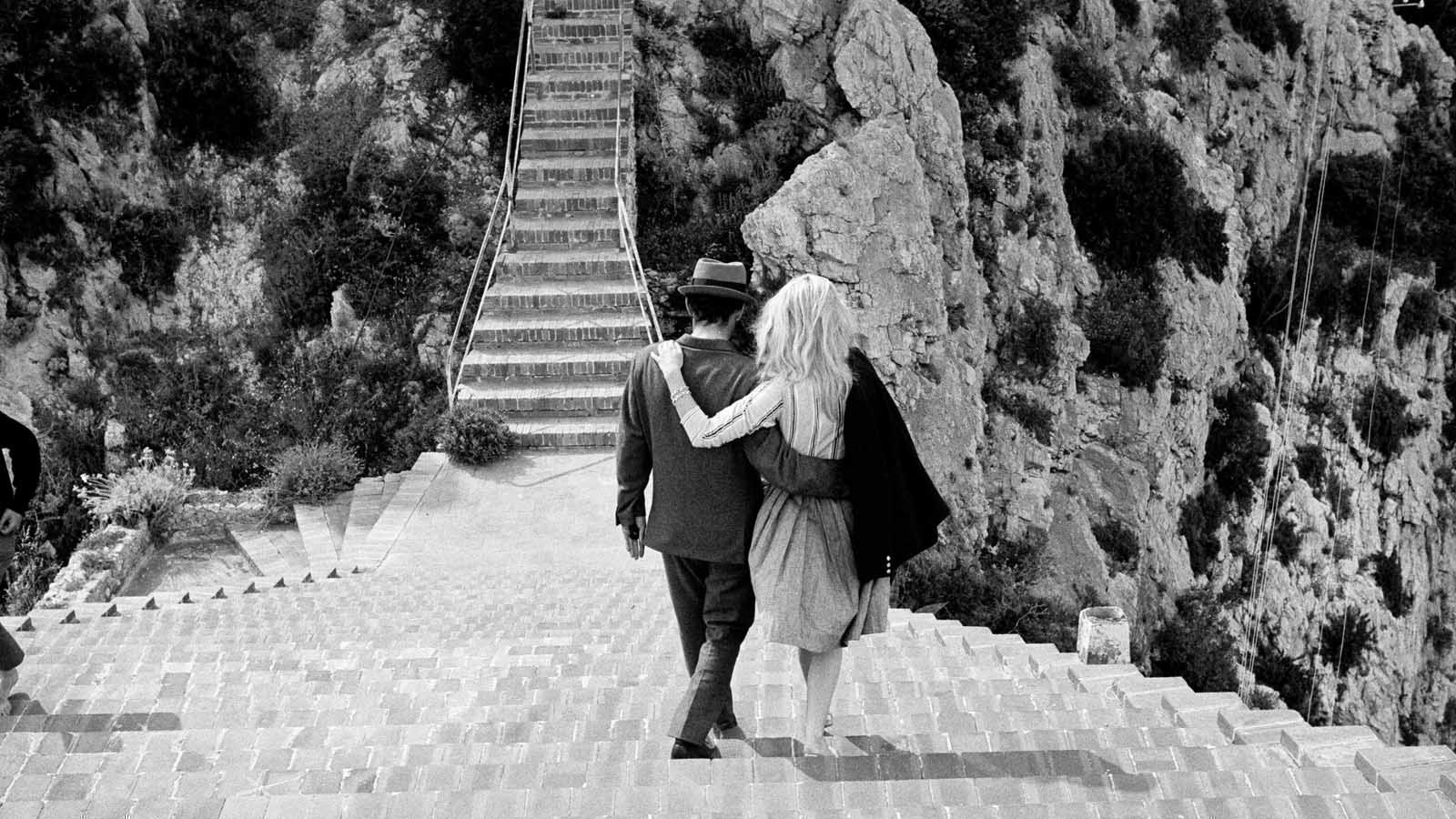
The excerpt finds Vianey on the Italian island of Capri, where Godard is shooting Contempt (1963). Vianey lunches with the director, who tells him that he does handstands to cheer up Brigitte Bardot, who, in turn, tells Vianey that “I like him, but he’s so weird . . . He’s in so much pain he can barely talk. You know what I mean?” Vianey did: “It made him hard to be around. Imagine a conscientious objector whose conscience objects to everything.”
In London, the Institute of Contemporary Art series Jean-Luc Godard: Unmade and Abandoned is currently running through June 21. The curator is Michael Witt, whose latest book is Jean-Luc Godard’s Unmade and Abandoned Projects. You need to subscribe to the New Left Review to read the entirety of Emilie Bickerton’s review, but the gist comes right at the top. Witt’s book is “a meticulous investigation of the Swiss-French director’s ‘non-corpus,’ as well as an experiment in a different kind of cinema history. Witt describes this as a ‘negative’ history, in which ‘the invisible work of project conception and development, meetings, planning, negotiations, deal-making, and interpersonal human relations that lies behind unmade and abandoned ventures is as integral and significant a part of cinema history as the completed films.’”
Bickerton wraps with Witt’s observation that Godard’s “finished works are like islands, which are really just mountain peaks visible above the surface of the water, while below it lie the many other hills of varying heights—the unrealized and abandoned ideas and ventures—that are integral to the landscape.” One last note before moving on from JLG: Spanish publishing house Contra has just released Jean-Luc Godard: Pensar entre imágenes, a collection of interviews, lectures, and conversations translated by Javier Bassas and Natalia Ruiz and edited by Núria Aidelman and Gonzalo de Lucas.
Liza with a Z
Liza Minnelli’s memoir Kids, Wait Till You Hear This! was released on March 10, two days before the daughter of Vincente Minnelli and Judy Garland and the EGOT-crowned star of Bob Fosse’s Cabaret (1972) turned eighty. “The problem with writing on Liza is also Liza’s problem,” suggests Tanya Gold in the Observer. “It is, basically: how much Judy?”
The answer seems to have been a lot. Garland, the headliner in January’s books roundup, was a one-of-a-kind knockout entertainer who was infamously hooked on the uppers and downers MGM fed her to keep her going. Her daughter writes that by the time she was thirteen, she was “my mother’s caretaker—a nurse, a doctor, pharmacologist, and psychiatrist rolled into one . . . Just as the MGM studio system robbed Mama of her childhood, she robbed me of mine.”
“If Judy is an invading demon in Liza’s book and mind, her father is a distant angel, available for a kind word but, apparently, little else,” finds Sam Wasson, the author of Fosse, at Air Mail. “The subject of this memoir, despite her lifelong war with her mother’s shadow, is still running, running, running from herself. ‘I’ve been asked countless times how I felt about Mama’s death, why she died and how it impacted me,’ she writes, adding, ‘I’m pretty sure I know why she died. Mama let her guard down.’ The conscious or unconscious vagueness of that observation alone is sufficient grist for a dual biography. Suffice to say, Liza is not about to repeat her mother’s mistake.”
In the New York Times, Alexandra Jacobs notes that Kids, Wait Till You Hear This!, twelve years in the making, has been “plucked, buffed, and powder-puffed within an inch of its long life by the Great American Songbook champion Michael Feinstein and two veteran newspaper writers.” But for Fiona Sturges in the Guardian, “If that sounds like too many cooks, the resulting book is surprisingly cohesive and spry.”
For those looking just for the juicy bits, Seth Abramovitch has you covered in the Hollywood Reporter. He’s got the lowdown on the beef with Lady Gaga, Minnelli’s discovery that her first husband was gay and that her fourth was a con man, and then, of course, the cocaine-fueled affair with Martin Scorsese during the making of New York, New York (1977).
More Outsized Personalities
At RogerEbert.com, Brian Tallerico recommends Martin Scorsese: All the Films, a new coffee-table book written by Olivier Bousquet, Arnaud Devillard, and Nicolas Schaller. Though it covers twenty-six fictional features, seventeen documentaries, seven short films, and four television episodes, “it’s more than just a Wikipedia-in-book-form project,” writes Tallerico. “It’s filled with insight, passion, and creativity.” And Nell Minnow talks with author Nelson Pressley about Fonda on Film: The Political Movies of Jane Fonda, which she finds to be “a delight to read, with historical context, behind-the-scenes details, and thoughtful observations.”
Newcity is running Scott Pfeiffer’s terrific conversation with Michael Glover Smith about his new book, Bob Dylan as Filmmaker: No Time to Think. The guideposts here are Eat the Document (1966) and the ways it differs radically from D. A. Pennebaker’s Dont Look Back (1967); Renaldo and Clara (1978), an even slipperier version of a story told in Rolling Thunder Revue: A Bob Dylan Story by Martin Scorsese (2019); and Masked and Anonymous (2003), directed by Larry Charles but very much a work sprung from one of the most pessimistic phases of Dylan’s ongoing evolution as an artist.
“For me, making films is second nature,” Gus Van Sant tells Violet Conroy at A Rabbit’s Foot. “Making paintings is more dependent on the work I put in.” Van Sant has been painting since he studied at the Rhode Island School of Design in the 1970s, but Gus Van Sant: Paintings is the first book to showcase his work. “There are themes that are similar to some of the films,” he tells Daisy Woodward at AnOther Magazine. “To me, it’s so different in the sense that the art piece is like an object and a film is more like watching a dream on a wall or something.”
Endnotes
On the New Books Network, Joel Tscherne talks with Stephen Lee Naish about Screen Captures: Film in the Age of Emergency, a collection that explores how “movies shape, and are shaped by, their audience’s own dissatisfactions.” Steven Shaviro has called Naish “one of our best film critics and cultural commentators,” and Naish’s next book, Post-Catastrophe Film: Cinematic Visions in the Aftermath of Disaster, will be out in May.
The independent publisher MACK is launching a new film series. The first three MACK Cinema Club screenings will take place at the ICA in London, beginning on April 8 with Bruce Conner’s Take the 5:10 to Dreamland (1974) and Todd Haynes’s Safe (1995), two favorites of photographer Larry Sultan, whose new collection is Water Over Thunder: Selected Writings. On May 27, Amelia Abraham, who has edited Sex, Clubs, Dissent: Visualizing Queer Nightlife, will present William Friedkin’s Cruising (1980) with contributing writer Asa Seresin. And artist Liz Johnson Artur (I Will Keep You in Good Company) will screen some of her own short films on July 15.
“Viewing a film has tremendous mystical implications; it can be, at its best, a way of approaching and manifesting the ineffable,” writes Nathaniel Dorsky in an excerpt up at e-flux from the new third edition of Devotional Cinema. For more recommendations, see Christopher Schobert’s latest roundup at the Film Stage, where he writes about fresh titles on the New Hollywood, Tilda Swinton, the Fast & Furious franchise, composer John Williams, Twin Peaks, and more.
Don’t miss out on your Daily briefing! Subscribe to the RSS feed.