One Battle After Another and Sinners Win Top Oscars
Share
Sunday night’s big winners at the ninety-eighth Academy Awards, both of them genre-blending front-runners throughout the monthslong awards season, not only tackle racism in America head-on but also complicate a plethora of related issues. Nominated for a record sixteen Oscars and the winner of four—Best Actor for Michael B. Jordan, Best Original Screenplay for director Ryan Coogler, Best Cinematography for Autumn Durald Arkapaw, and Best Original Score for Ludwig Göransson—Sinners is more upfront about it.
When Sinners opened last April, the Guardian’s Steve Rose spoke with Coogler, noting that he had set his film in “1930s Mississippi, close to where his own family originated before moving to California. The narrative weaves in the recent history of the era: slavery, reconstruction, the First World War; abject rural poverty; the Ku Klux Klan; Christian and African spiritualism; and the birth of the blues. ‘I’ve been struggling to tell a story that does the great migration for a while,’ he says. ‘It’s a personal obsession of mine, this period of time when Black people were considering leaving the south en masse.’”
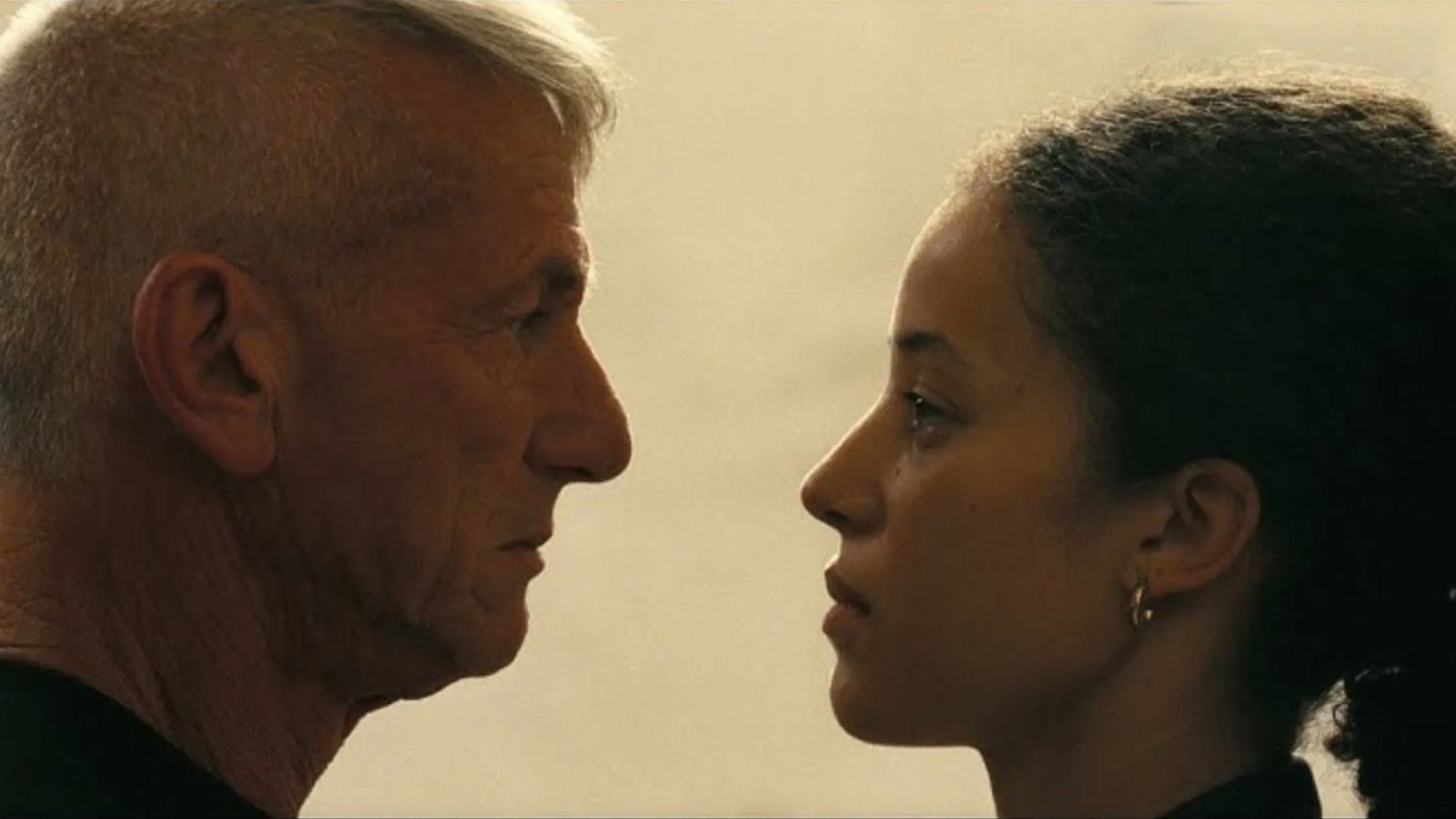
Paul Thomas Anderson’s One Battle After Another—which won six Oscars: Best Picture, Best Director, Best Adapted Screenplay, Best Supporting Actor for Sean Penn, Best Editing for Andy Jurgensen, and the new Best Casting Oscar for Cassandra Kulukundis—presents a thornier case. Black revolutionary Perfidia Beverly Hills (Teyana Taylor) hate-fucks Col. Steven J. Lockjaw (Penn) and leaves her baby to be raised by Bob Ferguson (Leonardo DiCaprio), an explosives expert who has become, on the one hand, a burnt-out stoner, but on the other, a dad who cares deeply for his young daughter, Willa (Chase Infiniti).
One Battle After Another
“Historically, a Black woman’s sexuality was something to be exploited or subdued,” writes Maya Phillips in the New York Times. “Here, the Black female revolutionary reclaims her sex, and even wields it as a weapon . . . Perfidia may be absent in her daughter’s life, yet her autonomy as a Black woman is nevertheless passed down to Willa as a birthright.”
But when scholar Daphne A. Brooks saw One Battle, she immediately texted NYT critic Wesley Morris, calling the film “a Black feminist 911 emergency.” In their conversation on the podcast Cannonball, Brooks doesn’t entirely win Morris over to her argument, but she’s not alone, as Anderson, who was asked in the press room backstage on Sunday about similar conversations, is fully aware.
Perfidia is “so flawed,” said PTA, “and unfortunately makes decisions that are detrimental to the revolution . . . We always knew that we were trying to make something complicated. We knew that we weren’t making something that was heroic, and we needed to lean into that . . . It’s a very dangerous thing when you start out, and you want to change the world and you start to kind of become selfish . . . That was our hero in Perfidia, who becomes an antihero. The point is to set up the story of Willa, the next generation. What happens when your parents, who are damaged, hand quite a difficult history to you? How do you manage that?”
At Slate, Sam Adams has a terrific piece about PTA’s long, long wait for recognition from the Academy. “Anderson’s was the most sustained losing streak of any writer-director in Oscars history,” notes Adams: Eleven nominations, zero wins. Now that streak is broken, and Adams argues that it is not simply because it was PTA’s “turn.”
One Battle is “a genuine peak,” writes Adams, “his most personal movie, his most politically relevant, and his most concerted attempt at a popular entertainment since Boogie Nights [1997], if not ever.” One Battle is “a buddy comedy, a father-daughter drama, and a conspiracy thriller in one, a movie of ideas and a slapstick farce, woven together with the kind of skill it takes a lifetime, or at least half of one, hopping between genres to pull off.”
Watching One Battle, Vulture’s Bilge Ebiri found himself thinking about passages from a few of Stanley Kubrick’s films. Penn’s Lockjaw, for example, calls Sterling Hayden’s Brig. Gen. Jack D. Ripper in Dr. Strangelove (1964) to mind. “Lockjaw not only fits the idea of the institutionally empowered madman,” writes Ebiri, “he’s also an archetype of the Kubrickian striver, a pathetic figure determined to both rise through the ranks and achieve a place within a seemingly eternal elect. That this man’s-man tough guy becomes utterly servile in the presence of a bunch of slack-casual bazillionaires is the cherry on top of the fascist sundae.”
Sinners
Penn, who may or may not be in Ukraine, wasn’t at the Dolby Theatre in Hollywood to accept his Oscar, but Michael B. Jordan very much was. “I stand here because of the people that came before me,” he said, holding his Oscar. “Sidney Poitier, Denzel Washington, Halle Berry, Jamie Foxx, Forest Whitaker, Will Smith. To be amongst those giants, those greats, amongst my ancestors, amongst my guides . . . Thank you everybody in this room and everybody at home for supporting me over my career. I feel it.”
The twins Jordan plays in Sinners, Smoke and Stack, set up a juke joint in the Deep South with money they’ve stolen from the mob in Chicago. Their younger cousin, Sammie (Miles Caton), lights up the place with “I Lied to You,” a tune so transcendent that it conjures spirits of performers from the past and future—and draws a clan of vampires as well. A reenactment of the scene was a highlight of Sunday night’s ceremony.
When Jordan won the Actor Award, the prize formerly known as the SAG Award, a couple of weeks ago, Wesley Morris rewatched Sinners and then wrote about coming around to an appreciation of Jordan’s dual performances: “That old Negro saw about Black people needing to be twice as good as everybody else is a joke you could make about Jordan having to play twins to beat four white men at the SAGs. But taking on two roles also animates the more existential Negro concept of double consciousness, that African Americans possess a pair of warring souls, one Black, the other American. That’s an idea made to hurt in the final stages of Sinners, a stretch in which Stack is made a vampire and therefore an undead recruit in a white man’s grungy army. He and Smoke tussle, one brother hoping to convert the other to the dark side, less for the evil than the eternal conjoining. And as they fight each other, their Black music oasis, this little American dream, goes up in flames around them.”
More Winners
As expected, Jessie Buckley won the Oscar for Best Actress in a Leading Role for her performance as Agnes Shakespeare in Chloé Zhao’s Hamnet. If you missed it last Thursday, see Isaac Butler’s terrific piece for Slate on what it is about Buckley’s talents and techniques that warrants the deep admiration of her peers.
Amy Madigan won the award for Best Actress in a Supporting Role for her turn as Gladys, a witch who drains the life force from a class of third-graders in Zach Cregger’s Weapons. “Madigan’s outlandish, creepy performance, with its orange wig of baby bangs and large gradient eyewear, was criticized as crone-shaming,” notes A. S. Hamrah in his big Oscars roundup for n+1, “but Weapons is in fact the rare film to address the problem of American gerontocracy head-on. In Gladys, we see a direct illustration of one generation taking the lives of another so that it can go on forever.”
As Nick Vivarelli reports for Variety, the Norwegian film industry is ecstatic over Joachim Trier’s Sentimental Value winning the Oscar for Best International Feature. KPop Demon Hunters, directed by Maggie Kang and Chris Appelhans, won not only Best Animated Feature but also Best Song (“Golden”). And Mr. Nobody Against Putin, primary school teacher Pavel Talankin’s record of the Russian government’s indoctrination of his students—codirected with David Borenstein—won the Oscar for Best Documentary Feature.
“Mr. Nobody Against Putin is about how you lose your country,” said Borenstein. “And what we saw when working with this footage is that you lose it through countless, small, little acts of complicity. When a government murders people on the streets of our major cities, when we don’t say anything, when oligarchs take over the media and control how we could produce it and consume it—we all face a moral choice. But luckily, even a nobody is more powerful than you think.”
Don’t miss out on your Daily briefing! Subscribe to the RSS feed.