Berlinale 2026: Loaded for Bear
Share
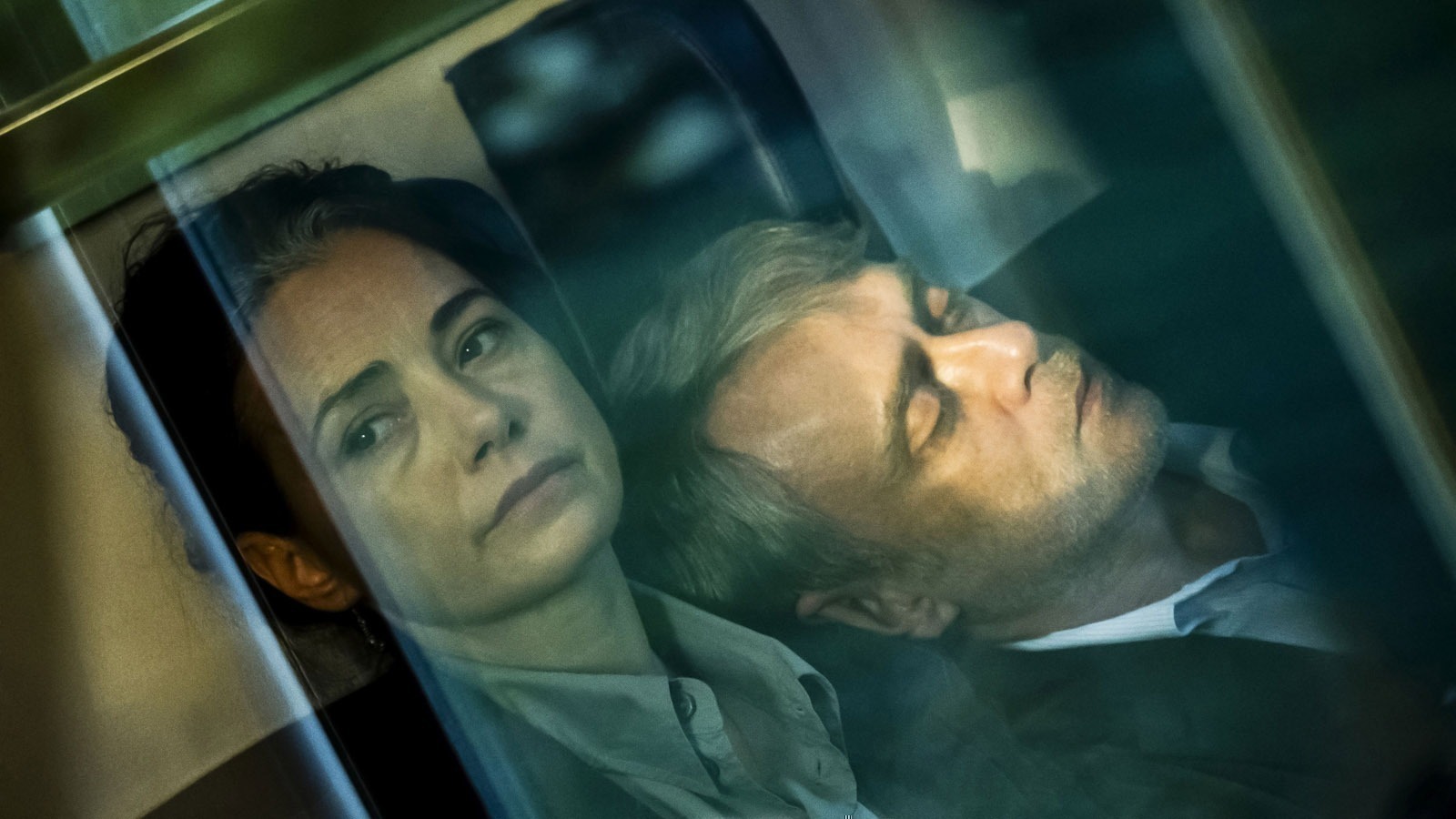
At the end of a politically charged and emotionally wrought awards ceremony on Saturday evening in Berlin, jury president Wim Wenders announced that the Golden Bear, the Berlinale’s top prize, was going to Yellow Letters. Directed by İlker Çatak (The Teacher’s Lounge), Yellow Letters is set in Turkey, with Berlin standing in for Ankara and Hamburg for Istanbul. As Siddhant Adlakha points out in Variety, it’s “as though the film itself were in political exile.”
Derya (Özgü Namal) and Aziz (Tansu Biçer) are a married actor and playwright whose latest production, an allegorical critique of Recep Tayyip Erdoğan’s government, is shut down. Derya is sent packing from her theater company, and Aziz, a professor who has called on his students to join a protest, is put on administrative leave along with several other teachers. Yellow Letters “might be the most important film yet made about Donald Trump’s America,” suggests Deadline’s Damon Wise. It’s “about the way dictatorships actually work, by hitting working people where it hurts—in the pocket.”
Before Çatak thanked his team, Wenders, and the festival, his producer, Ingo Fliess, noted that there’s a scene in Yellow Letters in which “former companions and friends argue with each other. Intellectuals against artists, all of them liberal-minded people. It reminded me of the last few days here in Berlin. Filmmakers against other filmmakers, artists against creatives. But we are not enemies. We are allies. The real threat is not among us. It is out there. It’s the autocrats. It’s the right-wing parties. It’s the nihilists of our time who try to come to power and destroy our way of living. Let’s not fight each other. Let’s fight them.”
The infighting, as Fliess characterized it, began on the first day of the festival’s seventy-sixth edition. Members of the international jury were asked, in light of the Berlinale’s outspoken solidarity with the people of Iran and Ukraine—a gesture that the festival has not extended to Palestinians—if they “support the selective treatment of human rights.” For the sake of context, keep in mind that the German government, an essential source of funding for the Berlinale, passed a resolution in 2024 declaring that certain—and, it must be said, ill-defined—forms of criticism of Israel would be classified as antisemitism and that any organization fostering its “spread” would be cut off from financial support.
That puts the Berlinale in a precarious position. As the host of hundreds of filmmakers from around the world, the festival cannot predict what any one of them might say, but it has said that it will resolutely defend their right to say it. This may have been in the back of Wenders’s mind when he responded to that opening-day question, but his choice of words set off an utterly predictable social-media firestorm. “We have to stay out of politics,” said Wenders. “We are the counterweight of politics, the opposite of politics. We have to do the work of people, not the work of politicians.”
By the next day, writer Arundhati Roy—who had been scheduled to attend a screening of a new restoration of In Which Annie Gives It Those Ones (1989), directed from her screenplay by Pradip Krishen—had withdrawn from the festival. “To hear them say that art should not be political is jaw-dropping,” said Roy. “It is a way of shutting down a conversation about a crime against humanity even as it unfolds before us in real time—when artists, writers, and filmmakers should be doing everything in their power to stop it.”
The Berlinale issued a statement the following day “in defense of our filmmakers, and especially our jury and jury president,” and the festival’s director, Tricia Tuttle, now in her second year, noted that it was “hard to see the Berlinale and so many hundreds of filmmakers and people who work on this festival distilled into something we do not always recognize in the online and media discourse.”
Three days later, an open letter eventually signed by more than a hundred current and former Berlinale attendees, including Tilda Swinton, Mike Leigh, Javier Bardem, and Nan Goldin, called on the Berlinale “to fulfill its moral duty and clearly state its opposition to Israel’s genocide.”
By this point, journalists were regularly asking actors and directors questions about Gaza, Trump, and the rise of right-wing nationalism in Europe. “The last place you probably want to look for advice in your spiritual counsel is a bunch of jet-lagged, drunk artists talking about their film,” said Ethan Hawke, who had come to Berlin to discuss his work with director Padraic McKinley on The Weight. He did add, though, that “anything that fights fascism, I’m all for it.”
When Saturday finally rolled around, Tuttle opened the awards ceremony with an address to those gathered in the theater and to the world at large. “This Berlinale has taken place in a world that feels raw and fractured,” she said. “Many people arrived carrying grief, anger, and urgency about what is happening far beyond these cinema walls. Those feelings are real. They belong in our community. We hear them . . . If this Berlinale has been noisy and emotionally charged, that is not a failure of cinema. That is the Berlinale doing its job. This is cinema doing its job.”
Silver Bears
Before his jury announced the winners of the main competition, Wenders read a statement distinguishing between the “empathetic” language of cinema and the “effective” language of social media. “Do our languages need to clash?” he asked.
Later in the evening, he told Désirée Nosbusch, the host of the ceremony, that he and his fellow jurors—filmmakers Min Bahadur Bham, Shivendra Singh Dungarpur, Reinaldo Marcus Green, and Hikari; actor Bae Doona; and producer Ewa Puszczyńska—had three clear favorites and that their most prolonged discussion revolved around which of the top three prizes would go to which favorites.
They went with gold for Yellow Letters, the Silver Bear Grand Jury Prize for Emin Alper’s Salvation, and the Silver Bear Jury Prize—as well as the Silver Bear for Best Supporting Performance to both Tom Courtenay and Anna Calder-Marshall—for Lance Hammer’s Queen at Sea. Set in a Turkish mountain village, Salvation is “notionally about the long-tail fallout from a land dispute, but more elementally about how violence happens,” writes Catherine Bray for Variety.
Mesut (Caner Cindoruk), the older brother of the local leader, has been seized by strange visions fueled by jealousy. It’s not that “Alper falls into the fallacy of laying everything that subsequently happens at one man’s door,” writes Bray. “On the contrary, this is a smart study of a community.”
In Queen at Sea, Hammer’s long-awaited follow-up to Ballast (2008), Calder-Marshall plays Leslie, an artist in the late stages of dementia. Her second husband, Martin (Courtenay), believes that physical intimacy can be at least consoling, if not healing, while Leslie’s daughter, Amanda (Juliette Binoche), objects on the grounds that her mother cannot consent.
Queen at Sea is “an unflinching, deeply upsetting movie,” writes Vulture’s Bilge Ebiri. “It’s also a disorienting one, which is where its true art lies. Hammer’s style limits our perception: The camera is often still, the compositions asymmetric. A looming stairwell might dominate a shot, while the characters speak in one far corner of the frame. Close-ups are often too close, blocking our view of the person speaking. And yet it’s all so exacting, so careful, as if to visually reflect the futility of control when reality is constantly slipping away.”
The Silver Bear for Best Director went to Grant Gee for Everybody Digs Bill Evans, starring Anders Danielsen Lie as the renowned jazz pianist and composer. Gee’s film focuses on a crucial period in Evans’s life, the immediate wake of the devastating loss of close friend and bassist Scott LaFaro.
An adaptation of Owen Martell’s short 2013 novel Intermission, Everybody Digs “honors the scope of its source, conveying a lifetime of mental illness, substance abuse, familial tension, and musical genius via a few months of intense grief and creative paralysis,” writes Guy Lodge in Variety. “What could feel contrived emerges as elegant and honestly felt, a study not just of the tumult that often produces great art, but the silence too.”
The Silver Bear for Best Lead Performance went to Sandra Hüller for her portrayal of a seventeenth-century woman who has taken on the identity of a man in order to claim his farm in Markus Schleinzer’s Rose. The role in this “austerely beautiful character study,” writes the Hollywood Reporter’s David Rooney, “is such a thrilling fit for Sandra Hüller—her flinty manner, her fierce conviction, her steely charisma and her incredible economy of means—that it becomes impossible to imagine any other actor nailing the part.”
Geneviève Dulude-de Celles won the Silver Bear for Best Screenplay for writing her second feature, Nina Roza, which tracks the journey of a Canadian immigrant back to his home land, Bulgaria, where he hopes to find a child artist whose work has gone globally viral. “It’s an intriguing set-up that takes a little time to find its way,” writes Jordan Mintzer in the Hollywood Reporter, “but once it does Nina Roza turns into a moving meditation on estrangement, revealing what you give up by leaving home behind—and what you gain by daring to finally return.”
Anna Fitch and Banker White won a Silver Bear for Outstanding Artistic Contribution for Yo (Love Is a Rebellious Bird),a tribute to an elderly friend of Fitch’s incorporating intricate models and stop-motion animation. Although the film is “limned with grief,” writes Leslie Felperin in the Hollywood Reporter, “it’s ultimately a deeply joyful work, crafted with painstaking care and precision.”
More Awards
Accepting her Golden Bear for Best Short Film for Someday a Child, the story of a boy with supernatural powers, Lebanese director Marie-Rose Osta denounced the bombing of her country—and was met with a vigorous round of applause. Pepa Lubojacki won both the Berlinale Documentary Award and the Caligari Film Prize for If Pigeons Turned to Gold, a probe into her family’s struggles with addiction.
Abdallah Alkhatib “brings mischief, mordant humor, and formal invention” to Chronicles from the Siege, mixing “harsh realism with a diverse panorama of the way in which people seize the possibility of joy even in the face of destruction,” writes Jonathan Romney for Screen. Accepting the award for Best First Feature, Alkhatib lambasted the German government for being “partners in the genocide in Gaza,” prompting Carsten Schneider, Germany’s minister for the environment, to walk out.
Before the ceremony, Teddy Awards, now in their fortieth year of celebrating queer cinema, went to Ian de la Rosa’s Iván & Hadoum, which Stephen Saito calls a “delicate drama about star-crossed lovers,” and Brydie O’Connor’s Barbara Forever, a tribute to pioneering lesbian filmmaker Barbara Hammer. The big winners from the Generation section programmed for younger viewers were Allan Deberton’s Gugu’s World, the story of a boy fighting to maintain the bond he shares with his grandmother, and Fernanda Tovar’s Sad Girlz, which Cineuropa’s Marta Bałaga calls “a bittersweet stunner. The Mexican director bets everything on female friendship, and wins.”
Panorama Audience Awards went to Faraz Shariat’s Prosecution, starring Chen Emilie Yan as a German state prosecutor seeking to uncover a network of right-wing extremists—the story becomes “a narratively propulsive yet finely detailed procedural,” writes Rory O’Connor at the Film Stage—and Alisa Kovalenko’s Traces, which focuses on six Ukrainian women speaking out about the sexual violence they have endured during Russia’s ongoing war against their country.
More than 270 films from around eighty countries screened at this year’s Berlinale, and even the total number of these winners of so many awards represents a mere fraction of the full lineup. Critics and juries are not always on the same page, and to hear about several critical favorites—some mentioned here, many not—turn to The Last Thing I Saw, a series of podcasts hosted by Nicolas Rapold, and the Moirée Podcast, featuring critics who rated films throughout this year’s volatile edition.
Don’t miss out on your Daily briefing! Subscribe to the RSS feed.