Once Upon a Time in Harlem
Share
Thirty-four years ago, the Sundance Film Festival played a key role in bringing long-overdue recognition to the work of William Greaves, the writer and director of more than a hundred nonfiction films. In 1992, Steve Buscemi was in Park City, where he caught a screening of Symbiopsychotaxiplasm: Take One (1968), which 4Columns film editor Melissa Anderson has called “an exhilarating, destabilizing amalgam of cinema verité and experimental narrative.”
Symbiopsychotaxiplasm had screened at festivals and museums but had never seen a proper theatrical release. Buscemi teamed up with Greaves and Steven Soderbergh to rectify that and to see through to completion one of the four sequels Greaves had planned, Symbiopsychotaxiplasm: Take 2½ (2005). When Greaves passed away in 2014, he and his wife and coproducer, Louise Archambault Greaves, were working on another long-simmering project they were calling Once Upon a Time in Harlem. On Sunday, Sundance hosted the premiere.
Greaves had set out in the early 1970s to tell the story of the Harlem Renaissance in its heyday, the 1920s. At the editing table, he and his assistant—his son, David Greaves—realized that the period photographs they had collected and the fresh footage they had shot were an uneven fit. They went with the stills, and the half-hour From These Roots (1974) features narration by Brock Peters (To Kill a Mockingbird) and a score composed and performed by the great ragtime and jazz musician Eubie Blake.
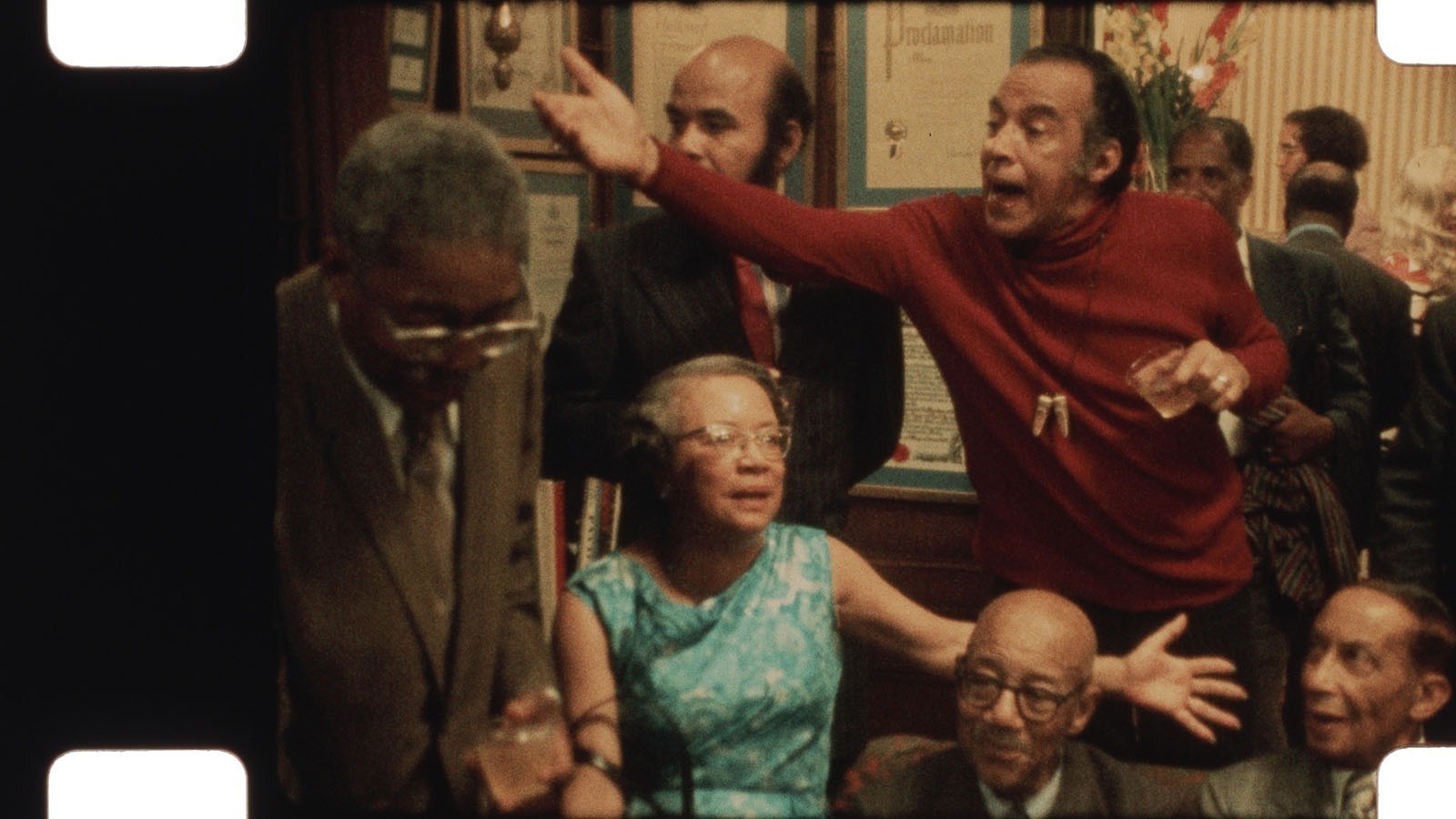
Much of the live-action footage William and David Greaves set aside was shot during a four-hour party at Duke Ellington’s apartment in 1972. With the help of Jean Hutson and Regina Andrews, two librarians at the Schomburg Center for Research in Black Culture, William Greaves had gathered several surviving artists, writers, and musicians associated with the Harlem Renaissance. Throughout that late afternoon and evening, he oversaw two teams of two cameramen—David was one—and one sound man each.
“In the later decades of his life, Greaves was not only certain that what he filmed that day in 1972 was the most important material of his career,” writes Patrick Fey at In Review Online, “it also confirmed how indebted he was to these remarkable progenitors of Black America. And yet, watching the film, you wouldn’t be able to tell the struggles involved, so irreverent are Greaves’s continuous zooms in and out, so effervescent the atmosphere, so unaffected the faces of most, and so entertaining those who noticeably do put on airs.”
“The restored footage captures the smoky air, the clanging of plates, the clack of heels on wooden floors, and the warm company of old friends and a few plus ones, leaning in when the conversation heats up,” writes Monica Castillo at the Playlist. Restoration of the footage began in 2021, and before she passed away in 2023, Louise Archambault Greaves handed the project over to David and his daughter, Liani Greaves, who would produce the completed film with Anne de Mare. “Don’t fuck it up,” Liani recalls in Zac Ntim’s interview with her and her dad for Deadline. “That was from Louise.” And David adds, “That was the only instruction we had, along with ‘make it happen.’”
When the New Yorker’s Richard Brody saw Once Upon a Time in Harlem as a work in progress last fall, he called it “one of the greatest cinematic works of creative nonfiction” that he had “ever seen.” The film captures “talk among friends but friends who are also clearly conscious that the gathering is making history as well as commemorating it. Passions run as high as style, and candor and fervor blend with humor, to endow anecdotes and reflections with pride and purpose along with mourning and indignation.”
“In one of the film’s many high points,” writes Vulture’s Bilge Ebiri, “the seventy-nine-year-old socialist and civil rights activist Richard B. Moore gives an impassioned, impromptu reading of Claude McKay’s ‘If We Must Die’ from memory. Not long after that, Leigh Whipper, the ninety-five-year-old cofounder of the Negro Actors Guild of America, recites the entirety of the speech he read as Haile Selassie in the 1943 film Mission to Moscow, complete with accent. The past doesn’t seem all that far away to these men.”
“There are moments, especially when the elder Greaves appears on camera, that you feel how much reverence and joy [he] had filming this,” writes Robert Daniels at RogerEbert.com. “After all, he grew up in Harlem, in the shadows of all these figures. Now, he’s in the same room.”
“The handheld footage and lively editing reproduces the energy of being at a bustling cocktail party, bouncing from one conversation to another, hearing a snippet of one interaction before being pulled into a larger discussion,” writes Kent M. Wilhelm at the Film Stage. “The two-dozen-or-so contemporaries, some of whom haven’t seen each other in half a century, reflect on the storied period in the early twentieth century with invigorating candor and spontaneity. They remember and honor; they debate and contest with arguments that reach a simmer but never boil over.”
As David and Liani Greaves tell Tayler Montague in Documentary Magazine, they hope to see a theatrical release of Once Upon a Time in Harlem in time to mark the hundredth anniversary of William Greaves’s birth on October 8. In the meantime, Liani Greaves notes that they are creating “a public-facing archive that folks will be able to watch and listen to the rest of the interviews and be able to access. Our mission is to really share this project as widely as possible and have people experience it.”
Don’t miss out on your Daily briefing! Subscribe to the RSS feed.