RELATED ARTICLE
Altered States: Visions and Divisions
The Criterion Collection
There are three unfortunate realities of writing a book about David Cronenberg: feeling unworthy of the task, actually sitting down and writing, and being asked about “body horror” over and over. The last of these is a social obligation made more difficult by the way, as both a genre and a discourse, its ever-thinning definition is used as a sheath to cover so much these days. Any bit of violence, gore, or goo—however brief or suggestive—means a film or TV show gets slapped with the label. Pointing this development out makes you sound like a cranky scold, but consider the abuse that “Hitchcockian” and “Lynchian” have suffered at the hands of publicists and unscrupulous fans who uncritically regurgitate marketing materials. The amorphousness of “body horror” makes me hesitant to engage with, or even a little hostile toward, new visual media touted as such.
That knee-jerk irritation comes from an understanding—and respect—for those who first generated the term. They were responding to a distinct cycle of films concerned with death, decay, and other forms of corporeal betrayal, and considering these works as texts about the body and mortality remains one useful way of approaching them (though it should never be the only way). The films in question don’t just evoke our primal fears, but engage them viscerally—thanks in large part to advances in makeup and special effects in the 1980s. One way to start to sketch the contours of the genre would be to trace the credits of SFX artists like Dick Smith, who developed a bladder system for the transformations in Altered States (1980) that would soon be used in An American Werewolf in London (1981), The Thing (1982), and many other films of the following decade, defining the visual look and practical techniques of body horror. But as with film noir, neither filmmakers nor studios were actively invested in positioning the films that gave rise to the label as body horror; instead, these films came out in a historically specific and malformed pattern that became identifiable only in retrospect.
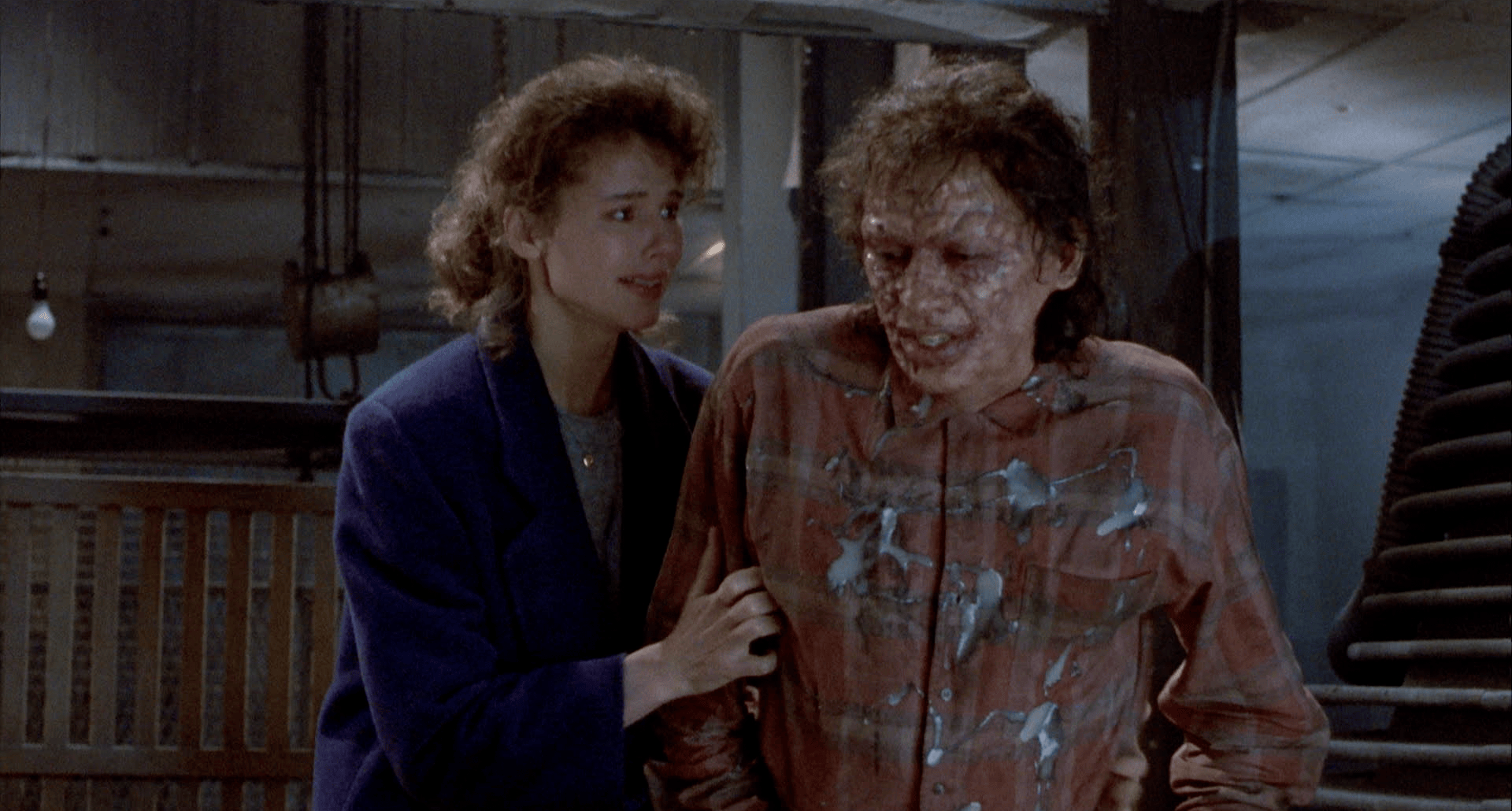
David Cronenberg’s The Fly (1986), an unrepentant exploration of loss of self and end-of-life shown through incredible practical effects, is an exemplar of the genre. Over the course of the film, Veronica “Ronnie” Quaife (Geena Davis), who was drawn to Seth Brundle (Jeff Goldblum) for his adorkable charm and groundbreaking teleportation technology, is forced to watch her lover become more and more monstrous, seeing pieces of his human body fall off, piece by piece, giving way to the mutant fly growing inside. Even Seth’s computer—his pride, joy, and rationalist tool for dealing with the biological chaos of the world—ceases to recognize his voice at a certain point, signaling a kind of death. Seth, initially excited by his transformation, imagining it as a purification, vacillates between hope and misery as he loses control of his human mind and body; he’s alternately Seth, an insect, and both at the same time. What once was can never be again, a rotten truth we all face.
At the end of the film, the manic Brundlefly attempts to physically merge himself with Ronnie and their unborn child, but accidentally fuses himself to one of his machines. Using a new, abominable limb created by his final trip through the telepods, Brundlefly positions the shotgun Ronnie holds directly at his head. Ronnie, sobbing, tells him no. And yet she summons the strength to pull the trigger—the effect of which is shown in visceral detail, making it nearly as painful for us as it is for her. Covered in blood, she collapses into a shuddering pile on the floor. The screen fades to black, offering her no way out. This is body horror.

In the late eighties and early nineties, when scholars like Carol Clover and Linda Williams began writing about horror, the genre was considered thoroughly disreputable and dangerous, an opinion that was the status quo even among film academics (this was the heyday of Andrea Dworkin’s read on pornography). For Clover and Williams, that louche nastiness was what in large part defined horror, which Clover termed a “body genre,” because horror films cause a physical reaction in their viewers (fear, sweating) that mimicked what was on the screen; Williams expanded upon this by labeling pornography (arousal) and melodramas (tears) as additional body genres. What made body genres so reprehensible to many—aside from the ethical dimension of showing sex or violent deaths of women on-screen—were their “excesses”: of sex, violence, and emotion. All three feature bodies shuddering with pain, fear, sexual ecstasy, and/or ugly-cries. Body genres are also focused on spectacle and the fantastic, but unlike an exhilarating musical number, their set pieces deliver sensational images of what we’re not supposed to see—blood, an orgasm, tears—registered in the extreme on female bodies.
If the term “body horror” is now applied to everything, perhaps it’s because the taboos it relied on have faded. Distinctions between high and low culture are gone, porn is everywhere, and gore is part of the online waters we all swim in. Although there are some (dull) cinephiles who still fail to take horror movies seriously, they’re shown at film schools and watched by people who don’t like blood all that much. This connection to the study of film is crucial: horror is distinct from other genres in part because it is so thoroughly plugged into (and in conversation with) academia. Consider Clover’s concept of “the final girl,” which has been popularized to the point that it’s routinely used within horror movies and even served as the title of two films made in the past fifteen years. As the genre’s tendency toward reflexivity has brought ideas like “body horror” into the mainstream, their more disreputable connotations have dropped away. Instead, their academic provenance serves an ennobling function: these movies are About Things, unlike the dumb, dirty genre pictures of the past. Other recently minted “genres” like “elevated horror” and “social thrillers” also evince this industry-led legitimization and “I’m not like the other girls” ethos. They broaden a film’s appeal beyond dedicated horror fans and open the door to awards. The recent success of The Substance (2024) and Titane (2021) is something Cronenberg only dreamed about for much of his career.
Per Philip Brophy, who coined “body horror” in a 1983 essay, “the contemporary Horror film tends to play not so much on the broad fear of Death, but more precisely on the fear of one’s own body, of how one controls and relates to it.” To state the obvious: this is an extremely broad set of parameters, and Brophy’s essay mixes the usual suspects of body horror as we’ve come to know it (The Brood, Scanners) with films that absolutely don’t fit (Deep Red). Unlike the obvious codes of the slasher film—a sharp-object-wielding villain (who’s human yet unrecognizably so), shots from the killer’s perspective, multiple victims, and that final girl—body horror is premised on a loss of bodily autonomy and agency by any mechanism. Zombie movies can be body horror, even though they have their own genre conventions. If I were an academic, I’m sure I could make the argument that anything from Flowers for Algernon or Dallas Buyers Club to that scene in Superman III where that lady villain becomes a computer-robot is body horror. But putting Dallas Buyers Club (which is about having AIDS in the eighties) next to The Fly (which, in the eighties, was widely understood as a metaphor for AIDS) seems wrong, a willful disregard for the subjective experience of actually watching and feeling a film.
Feeling, after all, is supposedly this genre’s unifying feature. But what is the feeling? Is it even generalizable? Plenty of movies have a rotten, disreputable, and somber tone; some of those even dare to show the abject: blood, shit, piss, etc. Conversely, plenty of classic body horror films are quite funny, and aren’t limited to gallows humor. Returning to Clover and Williams gives us one clue: unlike today’s award winners, the films that made this genre were déclassé and (actually) controversial upon their initial release. Some inspired widespread horror at their mere existence: Cronenberg’s Shivers (1975) led to parliamentary hearings on tax funding for all Canadian films, while Ichiro Honda’s Matango (1963) was almost banned because some of its SFX were reminiscent of radiation burns and mushroom clouds (even acknowledging the victims of Hiroshima and Nagasaki was outré in Japan at the time).
At the story level, it is not only the loss of bodily control that these films have in common, but also the creation—and then destruction—of a new body, one colonized by disease, mutilation, and mutation. The fantastical nature of these transformations draws out our own dormant terror of death and decay. Alongside these changing physical bodies, realized with special effects and puppetry, there are metaphorical bodies, specifically the “third person” that emerges from the romantic union or division of two souls. Sex and sexual desire is also really important in body horror for this reason: love isn’t simply a goopy, warm idea, but something physical. This is the vulnerable point that The Fly’s ending attacks. While not everyone has suffered the agony of a disease that upends (and then ends) their life as Seth does, Ronnie’s experience as helpless spectator to such destruction is far more universal. The unrelenting nature of The Fly’s double agonies—the fear of our own death and the fear of losing someone we love—is what makes it so powerful. Intimate relationships pose as dangerous (though more quotidian) a threat to these characters’ mental and bodily autonomy as reckless telepod experiments.
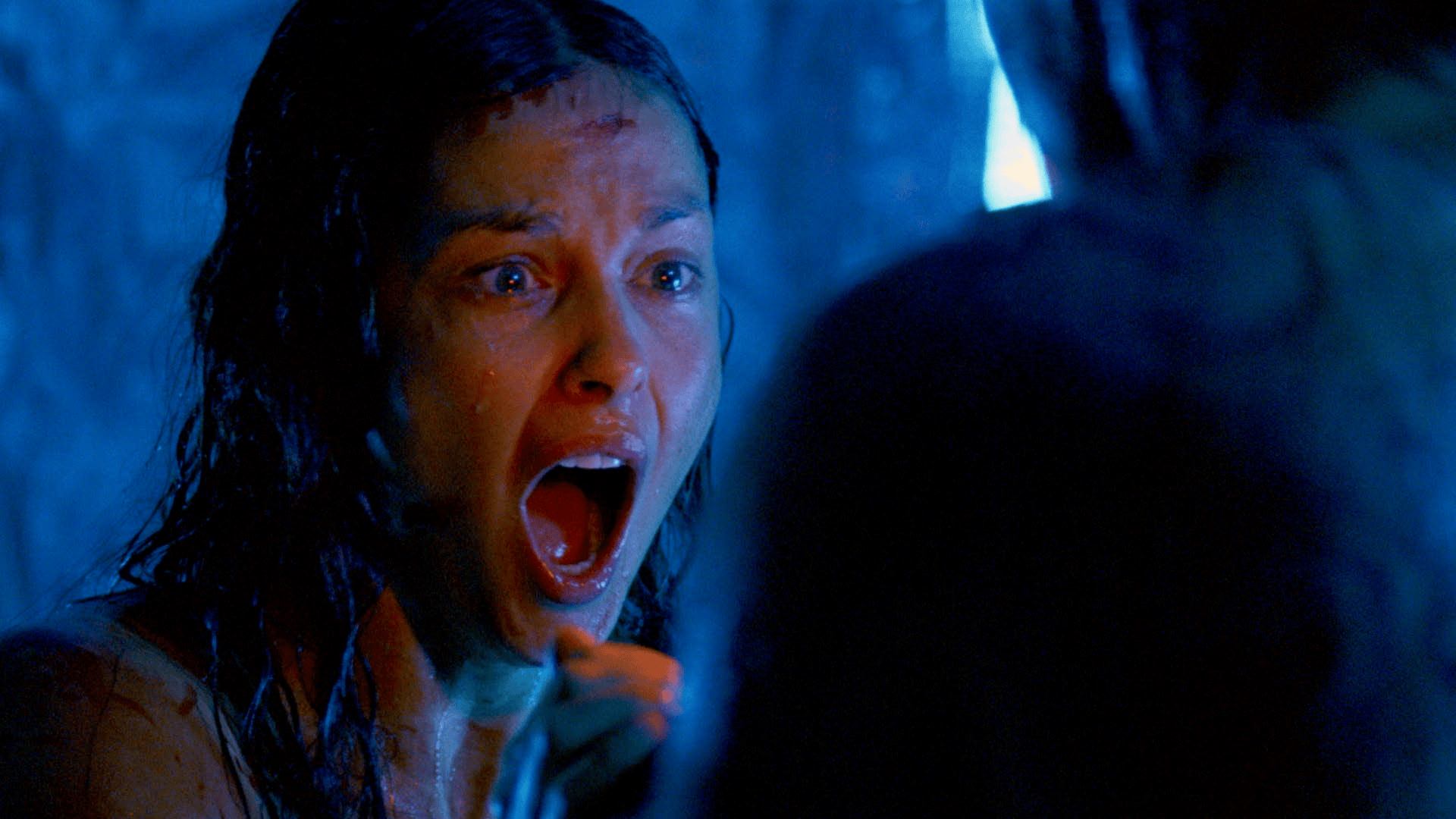
If the secure, independent Ronnie manages to resist her lover’s slide into madness till the end, William Friedkin’s Bug (2006) offers the spectacle of a female protagonist fully infected by her lover’s disordered thinking. Agnes White (Ashley Judd) spends her days alone, occasionally fielding silent, ominous calls, likely from her abusive ex. Years after her son was abducted at a supermarket, her life is frozen in a cycle of mourning and numbing the pain. An intense, taciturn man named Peter Evans (Michael Shannon) enters the picture, coming over to the rundown motel where Agnes lives for a bit of partying—blow, booze, weed, something that may or may not be meth. When they’re alone, Peter expresses a desire to stay and protect Agnes, without wanting sex, money, or anything else in return. The promise of a non-transactional companion, let alone a male one, is appealing to a woman who’s being harassed by her abuser.
What’s perhaps even more appealing about Peter is that he doesn’t present himself as a white knight, but merely a fellow lonely soul trying his best. He acknowledges the impossibility of true stability: “We’ll never really be safe again. Can’t be. Not with all the technology, chemicals. The information.” Bodily and mental autonomy are being constantly besieged by the modern world. However, these understandable, ambient fears are slowly revealed to be more Alex Jones than Naomi Klein. Peter starts being bitten by bugs—tiny ones that Agnes can’t see. He tells her that he’s been experimented on by the U.S. Army (something that does have historical precedent) but successfully escaped and is hiding from Them.

Upon hearing his confession, Agnes begs him not to leave, and their folie a deux begins in earnest. Agnes’s motel room is first decked out in fly strips, furniture encased in plastic covers, and enough Raid to kill every bug at Yellowstone. And yet, the bugs keep biting. Peter, whose abdomen is covered in open wounds, deduces that the army stuck a nest inside his dental work and pulls out some of his teeth, the extraction shown in all its bloody glory (here we come back to Clover and Williams’s concept of excess and spectacle.) Blood still gushing from his mouth, he puts a tooth under a microscope to show Agnes how many there are, and—finally seeing—she cries, “Millions!” The motel walls are then covered in tin foil, all lights are shut off save for giant bug lamps, and a bug net is romantically draped above their bed. Such precautions can’t stem the tide of this invasion. There is no barrier between inside and outside the apartment, nor between the two lovers; they have been led to this point by forces beyond their control. But their minds are still “free” and actively connecting the dots, in a paranoid spiral that leads to the conclusion that they themselves were the ones who created the bugs by having sex—again, that crucial third (or in this case, million-plus) body that’s so integral to the genre. In the film’s final moments, covered in blood and scratches, Agnes and Peter strip naked and assert their free will through self-immolation. Before the match is lit, Agnes tells Peter she loves him; that love is the uncontrollable force that’s dictated her every move.
Love as a rapacious, kinetic energy—and its vicious opposite during a breakup—is what Andrej Żuławski’s Possession (1981) is best known for: the squirming, the shrieking, the convulsing, the fuming line deliveries. Here the “body genre” effects are deployed cunningly: Żuławski believed that exhausting the viewer served a therapeutic purpose. The confusion caused by romantic separation permeates every frame; unlike most narrative feature films that establish clear cause and effect, the irrational is the norm here—something that makes it true to life, despite its bracing histrionics.
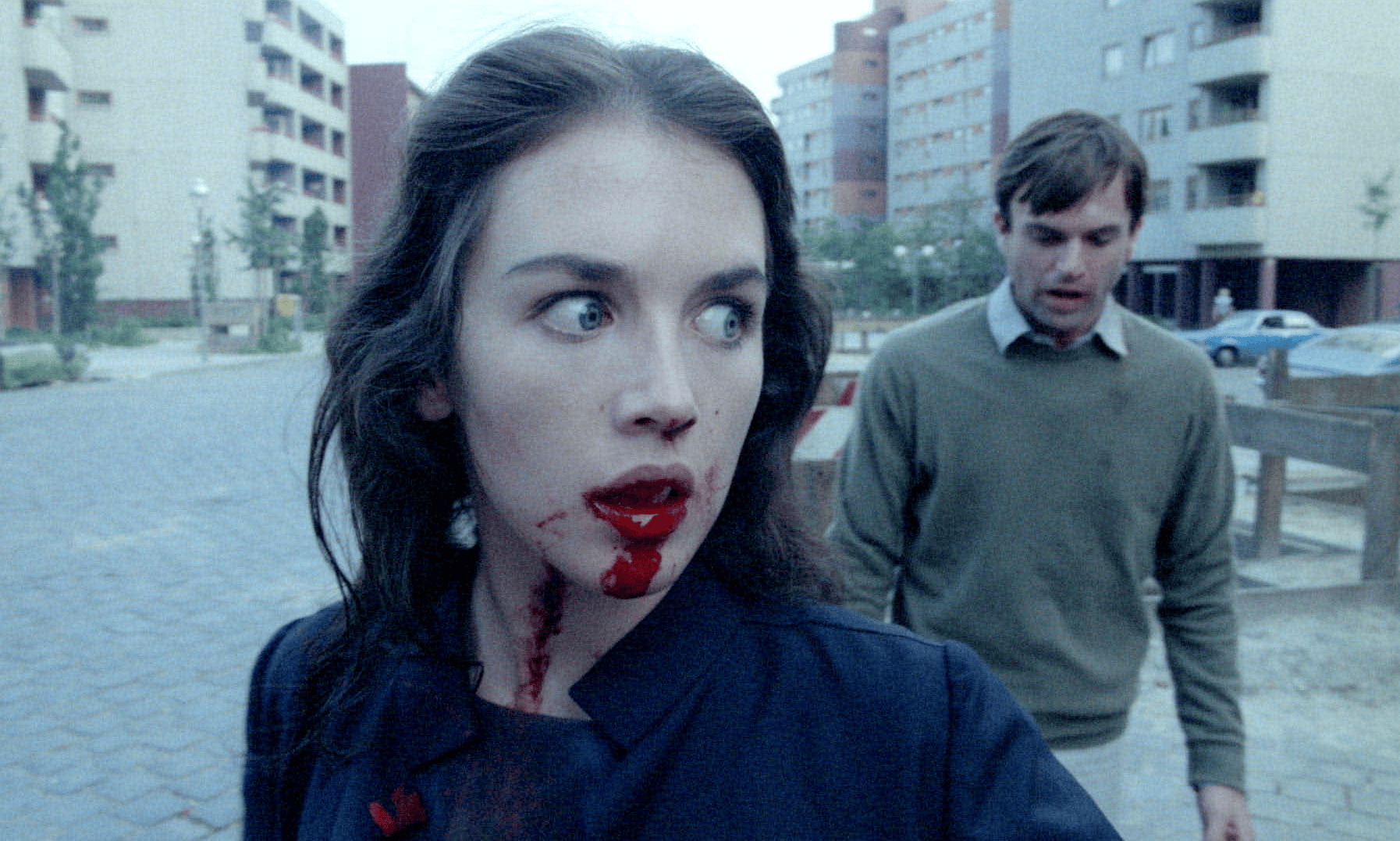
Mark (Sam Neill) has retired from espionage and returned to his wife Anna (Isabelle Adjani) and son Bob (Michael Hogben) in divided Berlin. Coparenting is made difficult not only by the couple’s raw emotions, which neither can physically or mentally control, but because of Anna’s tendency to vanish for days at a time. Suspecting infidelity, Mark eventually discovers that it’s not a who but a what that has its hold on her body and soul: a partially formed, nonverbal, tentacled monster that eats people and makes love to her all night. (The creature was made by Carlo Rambaldi, the SFX master who designed E.T. the following year.) Powerless against this dark force and unable to tell Mark what’s happening, Anna seeks relief in self-harm and a visit to a church, which precipitates the infamous miscarriage scene in the U-Bahn where white pus and blood ooze out of her orifices. Meanwhile, Mark (much like the divorced dad in Cronenberg’s The Brood) finds solace with his son’s teacher, who happens to look exactly like Anna, but with green eyes. Gentle, doting, and immune to fits of rage or sadness, she’s Anna with all the bad stuff taken out. As Mark attempts to clean up the trail of bodies left by Anna and her creature, he entrusts his son to this radiant doppelganger.
Yet the film’s climax threatens to replace Mark too. The ending finds him cornered by armed spies at the top of a staircase, where Anna appears with the creature, which now looks exactly like him. As it turns out, he isn’t actually that special to the person he loved most in the world. Mark and Anna die in a bullet-ridden heap, while Mark’s doppelganger slips away. The only characters left alive are Mark and Anna’s doubles, purified versions of the people they’re replacing—Seth Brundle would be jealous. This purity, of course, is illusory. When confronted with the manifestation of his parents’ rage attempting to enter his home, Bob, the other physical manifestation of Mark and Anna’s relationship, opts to drown himself in the bath as sirens blare outside. Though we never see the monster cross the threshold, Bob’s reaction reveals the creature’s true danger—and that kids know more than adults give them credit for.
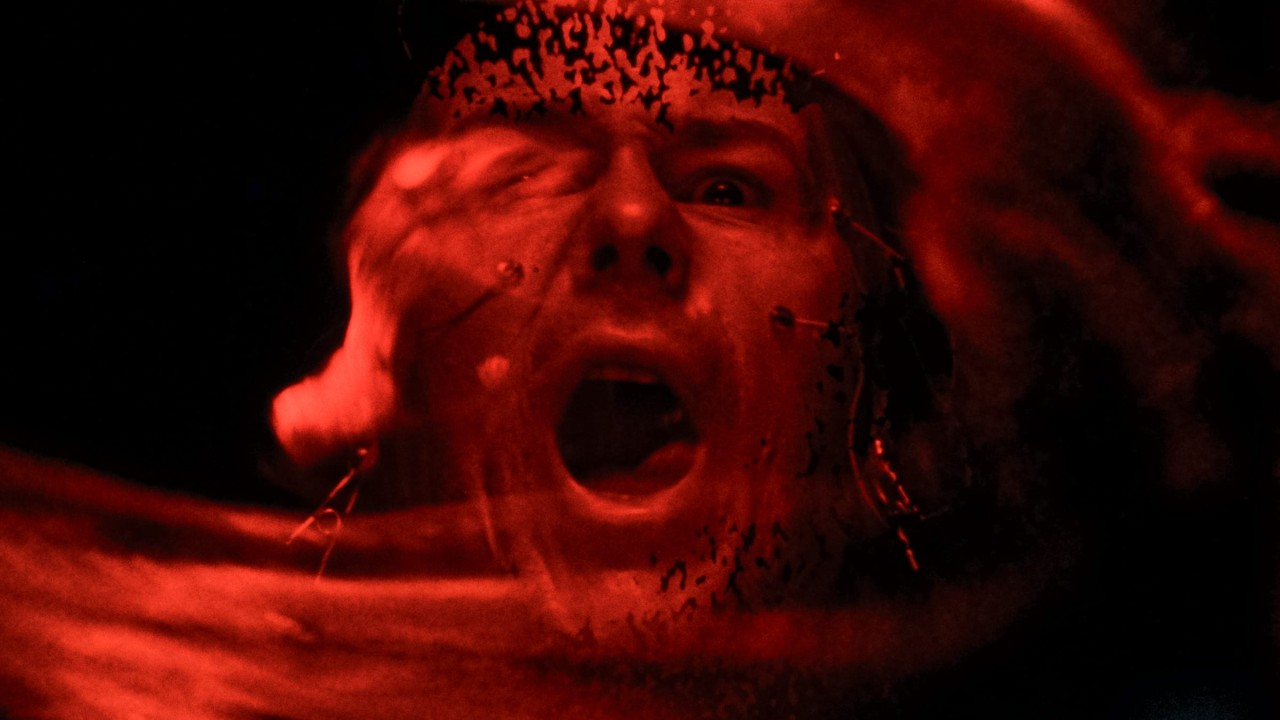
The mad scientist in Ken Russell’s Altered States is also tempted by the promise of purity, and destroys himself in pursuit of a “RTVRN.” Based on Paddy Chayevsky’s novel—which was inspired by John C. Lilly, the infamous scientist-psychonaut and dolphin communicator—the film follows the psychiatrist Dr. Edward Jessup (William Hurt) as he attempts to crack open human consciousness by taking hallucinogens and locking himself inside a sensory deprivation tank. (He also goes to Mexico and participates in a religious ritual overseen by a brujo, where his visions alternate between scenes of him and his wife dressed in English country-house finery admiring a field of giant orange flowers and the throbbing dancing of the masked natives around him—the superego pitted against the id. Somehow the university pays for this.) Floating in the dark of the tank, Edward has visions of early hominid life on the African savannah, then begins to regress physically during his trips: when he’s unable to speak after one experiment ends, an X-ray reveals that Edward’s throat is identical to a gorilla’s. He claims he’s returned to early hominid consciousness, the first inchoate thoughts. During an unsupervised trip, he transforms completely into a rampaging Monkey-Edward who escapes through Harvard, maims two men, and ends up at a zoo, where he successfully kills and eats a sheep raw. The zoo is an apt metaphor for what his research is actually doing: just gawping at things, not really understanding them.
Edward’s wife, Emily (Blair Brown), an equally renowned anthropologist, begins to more forcefully object to the experiments, believing they could cause permanent genetic damage. His obsessive behavior and “research” have led to their drifting apart. During his final trip, which Emily is present for, Edward touches something fundamental about the universe—something too profound to clearly define. A blinding white light explodes out of the submersion tank, blowing off its door and destroying the video feed. Edward’s body becomes even more unstable, and he writhes in agony as his body starts to look like throbbing silly putty. This sounds incredibly dumb, but it’s incredible to witness. After Edward miraculously recovers, he tells Emily that “the final truth of all things is that there is no final truth,” and chooses to focus on what’s in front of him: his wife and kids. This rather pat ending is frustrating: love conquers all, and the secrets of the universe pale in comparison to the light in your wife’s eyes. Instead of turning Edward into a bug or a paranoid or a sinister doppelganger, his partner pulls him back into the quotidian. In this instance, the transformation of romance and connection saves the day, a rare W in a genre full of bleakness and despair.
The director of Rat Trap and Monologue was an uncompromising artist who helped establish the Indian state of Kerala as a hub of bold political filmmaking.
Beginning on November 24, the Criterion Channel will exclusively premiere the long-awaited television series from visionary director Wong Kar Wai.
The self-trained filmmaker examined postindependence Nigerien society in morality tales that showcased his visual ingenuity and sly sense of humor.
This French art-horror master shocked audiences with a string of sexy vampire movies often centered on complex female friendships and women-ruled fantasy worlds.