A History of Violence: Dead in the Eye
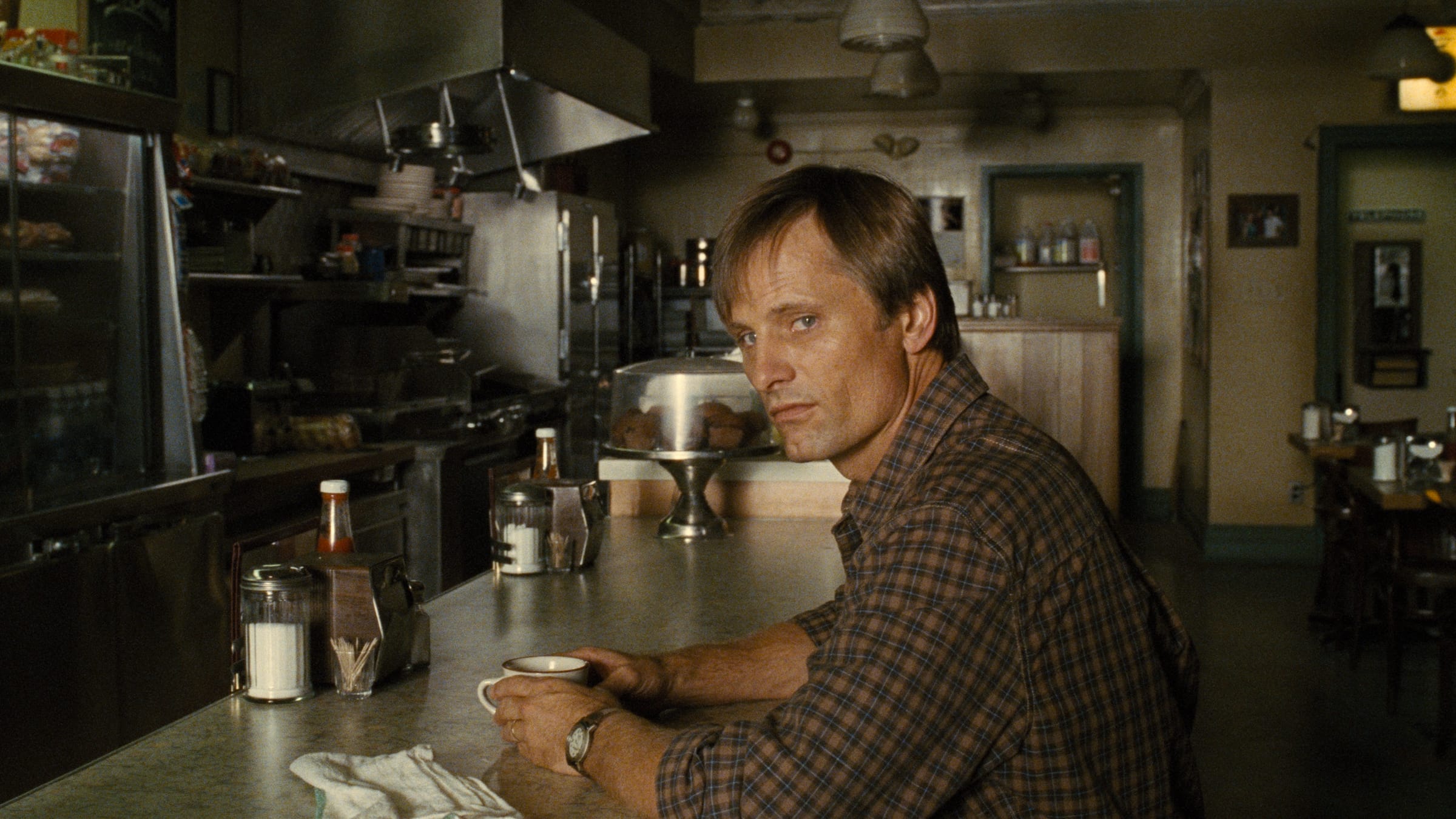
David Cronenberg had long been revered as a contemporary master when A History of Violence struck the 2005 Cannes Film Festival like a bolt of lightning. Here was, from a filmmaker renowned for his audacity and originality, yet another provocation: an old-fashioned crime thriller set in America. Things, however, are rarely what they seem in Cronenberg’s cinema, and like many of the locales evoked in his work—the Tangier of Naked Lunch (1991), the China of M. Butterfly (1993), the Manhattan of Cosmopolis (2012)—the small town of A History of Violence feels bracketed in quotation marks, a topography of the mind. Nominally set in the present, the film channels the heightened Americana of a midcentury Nicholas Ray or Douglas Sirk picture: postcard-perfect Main Street, darn good coffee at the diner, baseball games and high-school greasers, fields of corn and improbably resplendent autumnal foliage, meat-loaf dinners with sides of peas and carrots. Welcome to idyllic Millbrook, Indiana, where everyone knows your name—or so it seems.
The story of a normal joe (Viggo Mortensen as Tom Stall) whose past comes back to haunt him with a vengeance, A History of Violence is a devious entertainment with a sly conceptual backbeat that places each of its actions under examination. The film operates on a double register, simultaneously offering us rip-roaring action and a sustained interrogation of its own conventions: the movie’s success is predicated on a logic of simulation at work beneath the execution of genre mechanics. (The production itself was an exercise in mimicry, with the real town of Millbrook, Ontario, standing in for “Millbrook, Indiana.”) Despite its many twists and turns, the plot is succinct, lucid, and bracingly direct, paring revenge-thriller tropes to their essence to maximize (and problematize) their effect.
Loosely adapted, by screenwriter Josh Olson, from a nearly three-hundred-page graphic novel by John Wagner and Vince Locke, the movie opens with a slow, sinister tracking shot. A pair of hoodlums (Stephen McHattie and Greg Bryk) casually lay waste to a roadside motel, slaughtering the owners and, in a sequence that takes us right to the edge of what feels permissible to show, murdering their daughter. In a movie rampant with unflinching kills, hers is the only one we’re spared; a smash cut transposes her scream into the mouth of young Sarah Stall (Heidi Hayes) as she bolts awake from a nightmare. “There’s no such thing as monsters, sweetie,” her father, Tom, consoles, as the other members of the Stall family, mother Edie (Maria Bello) and teenage son Jack (Ashton Holmes), gather in her bedroom. This statement will soon be rendered deeply ironic, as their American dream implodes.
Having established the presence of evil and its ostensible counterpart, the lawful-good nuclear family, A History of Violence proceeds to sketch out its world. Tom, a soft-spoken, churchgoing pillar of the community, runs the local diner. Sensitive, intelligent, and a begrudging gym-class outfielder, Jack is cornered in the locker room by jocks who label him a “faggot.” Meanwhile, in a zestier display of sportsmanship, Edie surprises Tom with bedroom role-play, emerging from the bathroom in a cheerleader outfit. “Holy cow,” Tom marvels. “What have you done with my wife?” All the characters populating this curious American fantasia, we begin to intuit, are to some extent performing.
More: Essays
God Laughs: Stanley Kubrick’s Cinema
Throughout his enormously influential body of work, the great director explored the conflict between humankind’s obsession with control and our capacity for error and failure.

Christiane F.: Up Against the Wall
Uli Edel’s harrowing tale of youth rebellion is one of cinema’s greatest Berlin films, a visceral urban portrait that captures the city’s doom and decadence during the Cold War era.
The Shout: Sound and Fury
Blending elements of psychological thriller, social satire, and psychedelic film, Jerzy Skolimowski’s Cannes-award-winning classic uses its audacious sound design to evoke the terror of English civilization.
Welcome II the Terrordome: The Future Is Furious
A dystopian drama that draws on the influences of African mythology and hip-hop, Ngozi Onwurah’s debut feature uses a mix of speculative forms to expose anti-Blackness as a system that underpins the modern world.