The Indomitable Claudia Cardinale
Share
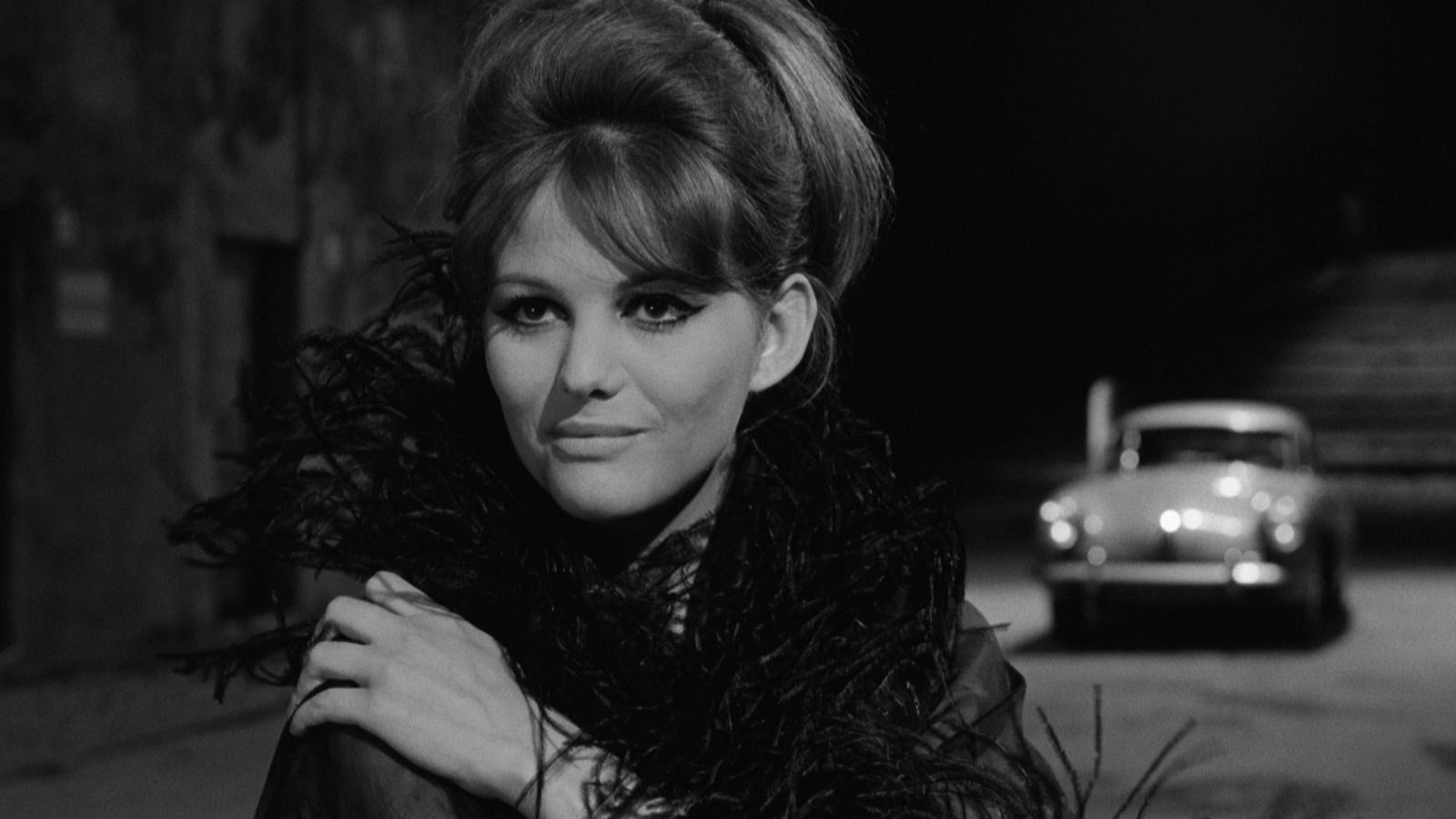
In Luchino Visconti’s The Leopard (1963), set in the 1860s, Tancredi, the upstart nephew (Alain Delon) of a Sicilian prince (Burt Lancaster), insists that if the family is to survive the rise of a new middle class, it will have to change its ways. Surveying Visconti’s oeuvre in the Village Voice in 2018, Bilge Ebiri wrote about an “indelible moment” in The Leopard, the “breathtaking entrance of Claudia Cardinale.”
“Playing the mysterious daughter of a local official, she hesitantly walks into a dinner party,” wrote Ebiri, “and every head in the room turns—including that of Tancredi, who will eventually marry her and cement his place in the emerging new class, a nobleman marrying down to preserve his status. But here, in this instance, as Cardinale enters and captures Delon’s eye, we see, expressed with the full force of cinematic style and star power, the promise of an onscreen couple presented as if it were the realization of a historical process: These are two of the most beautiful humans on Earth, and it’s inevitable that they will find each other in this room. Delon will meet Cardinale. The nobleman will meet the middle-class girl. Wealth will preserve itself. The Italian idea will survive.”
Cardinale, who has passed away at the age of eighty-seven, was the daughter of Sicilians but didn’t speak Italian until she was an adult. She grew up in Tunisia speaking French, Arabic, and the Sicilian dialect of her parents. While studying in Carthage, she was cast along with a few other classmates in Anneaux d’or (1956), a short film directed by René Vautier that caught the eye of Jacques Baratier, who needed a Tunisian actress for Goha (1957), the first feature not only for Baratier and Cardinale, but also for its star, Omar Sharif.
But Cardinale had little interest in acting, much less in becoming a star. The movies, though, seem to have demanded to have her. Versions of the story vary, but she either entered or was entered into a beauty pageant and was crowned the “Most Beautiful Italian Girl in Tunisia.” The prize was a trip to the Venice Film Festival, where she wore an emerald green bikini and attracted a swarm of photographers.
In Claudia Cardinale: The Indomitable, a book published on the occasion of a 2023 retrospective organized by New York’s Museum of Modern Art and the Italian studio Cinecittà, author and critic Masolino D’Amico wrote that Cardinale “seemed to think that small shower of camera clicks was like a game. She was not—I understand this clearly now—trying to be sexy, and maybe not even attractive. She was simply happy to be there.”
Since she was seventeen, Cardinale had been in a relationship with a Frenchman ten years older. At nineteen, she was pregnant, and the Frenchman split. After her son was born, producer Franco Cristaldi offered marriage, his name to the boy she was to pass off as her younger brother, and a seven-year contract. Cristaldi micromanaged her career until they parted ways in 1975.
Mario Monicelli’s Big Deal on Madonna Street (1958), a comedic crime caper and international hit costarring Vittorio Gassman, Renato Salvatori, Marcello Mastroianni, and Totò, made Cardinale a star. She was soon working with the likes of Alberto Cavalcanti (Venetian Honeymoon) and Pietro Germi (The Facts of Murder), and 1960 found her working for the first time with Visconti and Delon when she was cast in a small role in Rocco and His Brothers. In her 2005 autobiography My Stars, Cardinale wrote that “Visconti taught me how to be beautiful. He taught me to cultivate mystery, without which, he said, there cannot be real beauty.”
That same year, she costarred with Mastroianni in Mauro Bolognini’s biting satire Il bell’Antonio, an adaptation of Vitaliano Brancati’s novel written by Pier Paolo Pasolini and the winner of the Golden Leopard in Locarno. Cardinale also worked with Abel Gance on Austerlitz, and then the following year, she starred in Valerio Zurlini’s Girl with a Suitcase. In the Village Voice, Jonas Mekas called her character “uneven, confused, but alive. Read [Alberto] Moravia’s interview with her in Esquire, a beautiful piece of writing. She is wild, and beautiful at moments, a sort of neo-B. B.”
Cardinale would have liked that. As a teen, she and her friends were big fans of Brigitte Bardot, and in 1971, Cardinale and Bardot costarred as outlaw sisters in Christian-Jaque’s comedic western The Legend of Frenchie King. But the stellar year for Cardinale was 1963, when she appeared not only in The Leopard but also in Federico Fellini’s 8½, Luigi Comencini’s Bebo’s Girl, and in her first Hollywood movie, Blake Edwards’s The Pink Panther. One of her costars in that one, David Niven, famously quipped that Cardinale was Italy’s greatest invention after spaghetti.
Last year, Stephanie Zacharek wrote that Mastroianni’s aimless director in 8½, Guido, “finds peace only in a fantasy: he sees a vision of the perfect woman—he describes her as ‘both young and ancient, a child but also a woman’—dressed in white, offering him a glass of [a spa’s] holy water with a smile. This is Claudia Cardinale—later she will appear in the film as an actress named Claudia—and to Guido, the exquisite simplicity of her beauty is the antidote to all his real-life problems.”
During her three-year stay in the States, Cardinale appeared alongside John Wayne and Rita Hayworth in Henry Hathaway’s Circus World (1964), but soon enough, she was back working Visconti again on Sandra (1965), a retelling of the story of Electra that won the Golden Lion in Venice. She reunited with Burt Lancaster in Richard Brooks’s western The Professionals (1966) and costarred with Tony Curtis in Alexander Mackendrick’s comedy Don’t Make Waves (1967).
Reviewing Once Upon a Time in the West (1968) in the Voice, Andrew Sarris called it “Sergio Leone’s most American Western, but it is still dominantly and paradoxically European in spirit, at one and the same time Christian and Marxist, despairing and exultant, nihilistic and regenerative.” It’s “essentially a silent movie with aphoristic titles for dialogue. All the dialogue could be eliminated from the movie, and we would still have been shown all that it is essential to know about the obsessive concerns of the characters. We would come to understand Claudia Cardinale’s role as the bearer of water, life, and continuity to the civilization of the New West.”
Cardinale went on to work with Jerzy Skolimowski (The Adventures of Gerard, 1970), Alberto Sordi (A Girl in Australia, 1971), and Marco Ferreri (The Audience, 1972). On the set of Blood Brothers (1974), she and director Pasquale Squitieri fell hard for each other, had a daughter, and made several more features together.
The standout film of the following decade for Cardinale was Werner Herzog’s Fitzcarraldo (1982), which she once claimed was “the best adventure of my life.” She plays Molly, the owner of a brothel who finances the dream of an Irishman, Fitzcarraldo (Klaus Kinski), of bringing opera to the Amazonian jungle. “She was such a good element to bring Kinski to his senses sometimes,” Herzog once said. “She was such a good comrade. I think that she was one of the one or two female partners that he ever respected.”
After Fitzcarraldo, Cardinale appeared in Marco Bellocchio’s Henry IV (1984), Nadine Trintignant’s Next Summer (1985), and Diane Kurys’s A Man in Love (1987). An outspoken feminist, Cardinale became a UNESCO goodwill ambassador for the Defence of Women’s Rights in 2000, and the new millennium found her working not only with Manoel de Oliveira (Gebo and the Shadow, 2012) but also with such women directors as Nicole Garcia (A View of Love, 2010) and Nadia Szold (Joy de V., 2013).
In 2017, when Cannes celebrated its seventieth anniversary, the festival put a 1959 photo of Cardinale swirling on a rooftop in Rome on its official poster. A mild online brouhaha was kicked up when some people pointed out that the photo had been retouched to make Cardinale appear thinner than she was. Cardinale brushed it off: “This image has been retouched to accentuate this effect of lightness and transpose me into a dream character. This concern for realism has no place here and, as a committed feminist, I see no affront to the female body. There are many more important things to discuss in our world. It’s only cinema.”
Don’t miss out on your Daily briefing! Subscribe to the RSS feed.