Deeper into Altman
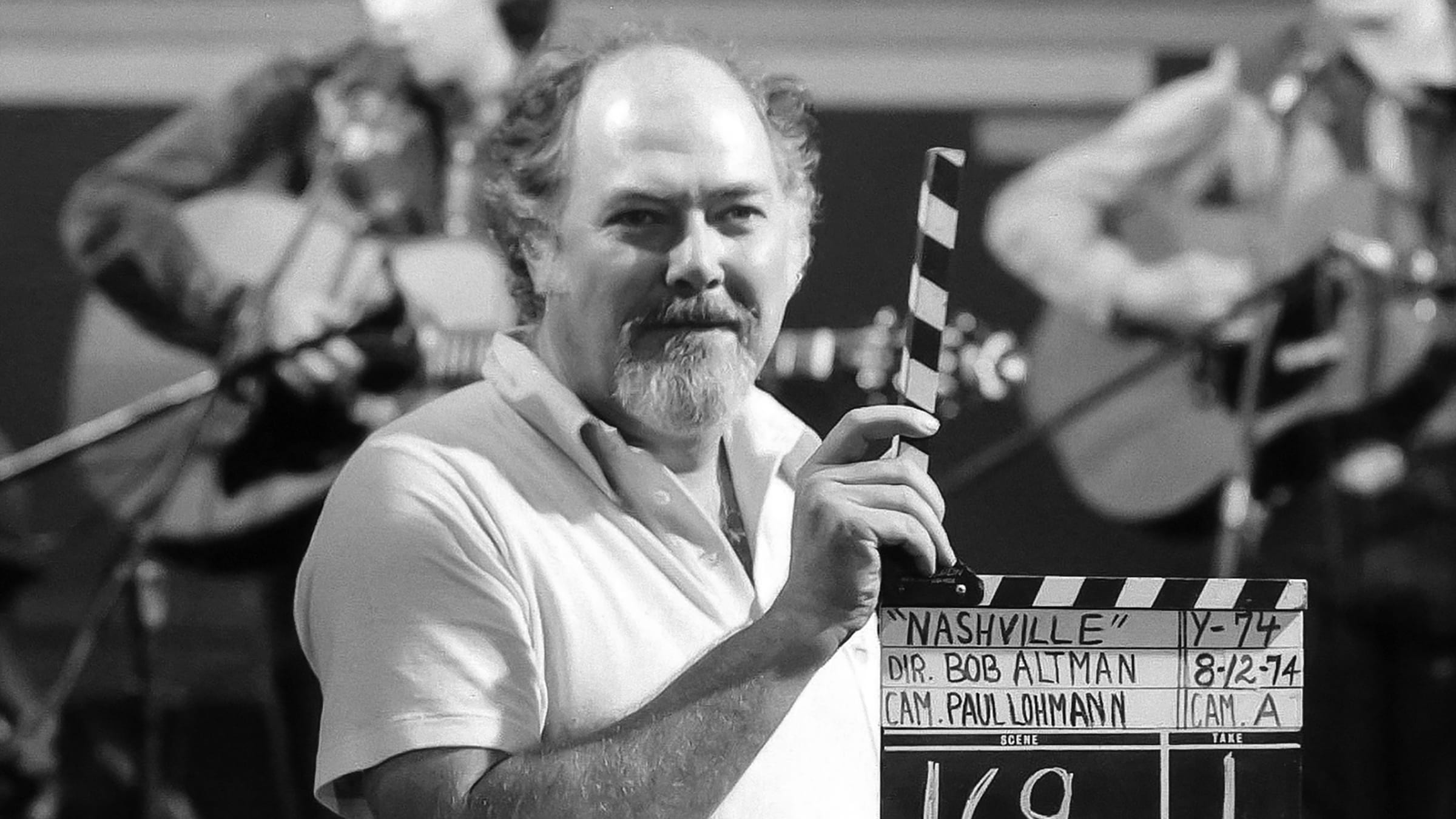
Robert Altman’s name is synonymous with cinematic plenitude: big ensemble casts, cascades of overlapping dialogue, loose and freewheeling narratives, and movies generously stuffed with more human detail than a single viewing can take in. But his films come in all shapes and sizes, and his wildly prolific career contains many surprising detours into unexpected genres and modes, from science fiction to comedic fantasy. This is especially true if you look beyond the legendary run of films that made the director’s name in the 1970s. As critic Sean Fennessey puts it in the introduction to our Altman retrospective, “You might say there are significantly more deep cuts in Altman’s career than there are classics—which is saying something since he has quite a few classics.” To celebrate Altman’s centennial, we invited five writers to each explore a favorite lesser-known gem from this overflowing filmography.
That Cold Day in the Park (1969)
By Bruce LaBruce
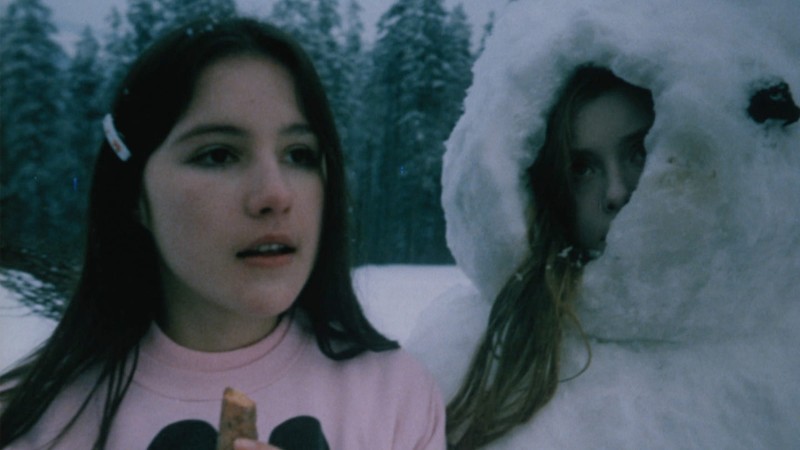
To say that the early Robert Altman masterpiece That Cold Day in the Park had an influence on me as a filmmaker would be an understatement: it spurred my pornographic imagination to such a degree that I remade it as my first stab at a feature, No Skin Off My Ass (1991), an experimental queer super 8 art/porn opus that Kurt Cobain cited as one of his favorite movies. When I first watched the film as a teen on Canadian TV, I thought (long before the internet) that this must be what people were referring to when they used the word pornographic, such was my beguilement by the perverse and lurid psychosexual drama that unfolded before my precocious yet virgin eyes. The fact that there are only glimpses of nudity and no explicit sex didn’t change my assessment! I was already aware of Sandy Dennis from her Oscar-winning turn in Who’s Afraid of Virginia Woolf? (full disclosure: I have a Sandy Dennis tattoo), but somehow I still wasn’t quite prepared for the kinky, slow-burning insanity of Frances Austen, identified on one of the posters for the film as “a thirty-five-year-old spinster.” The mind already reels. The narrative has the lonely woman take in a mute, abject young man she sees soaking in the rain on a park bench, bathe him, feed him, and subsequently confine him in the guest room with designs on making him her sexual captive.
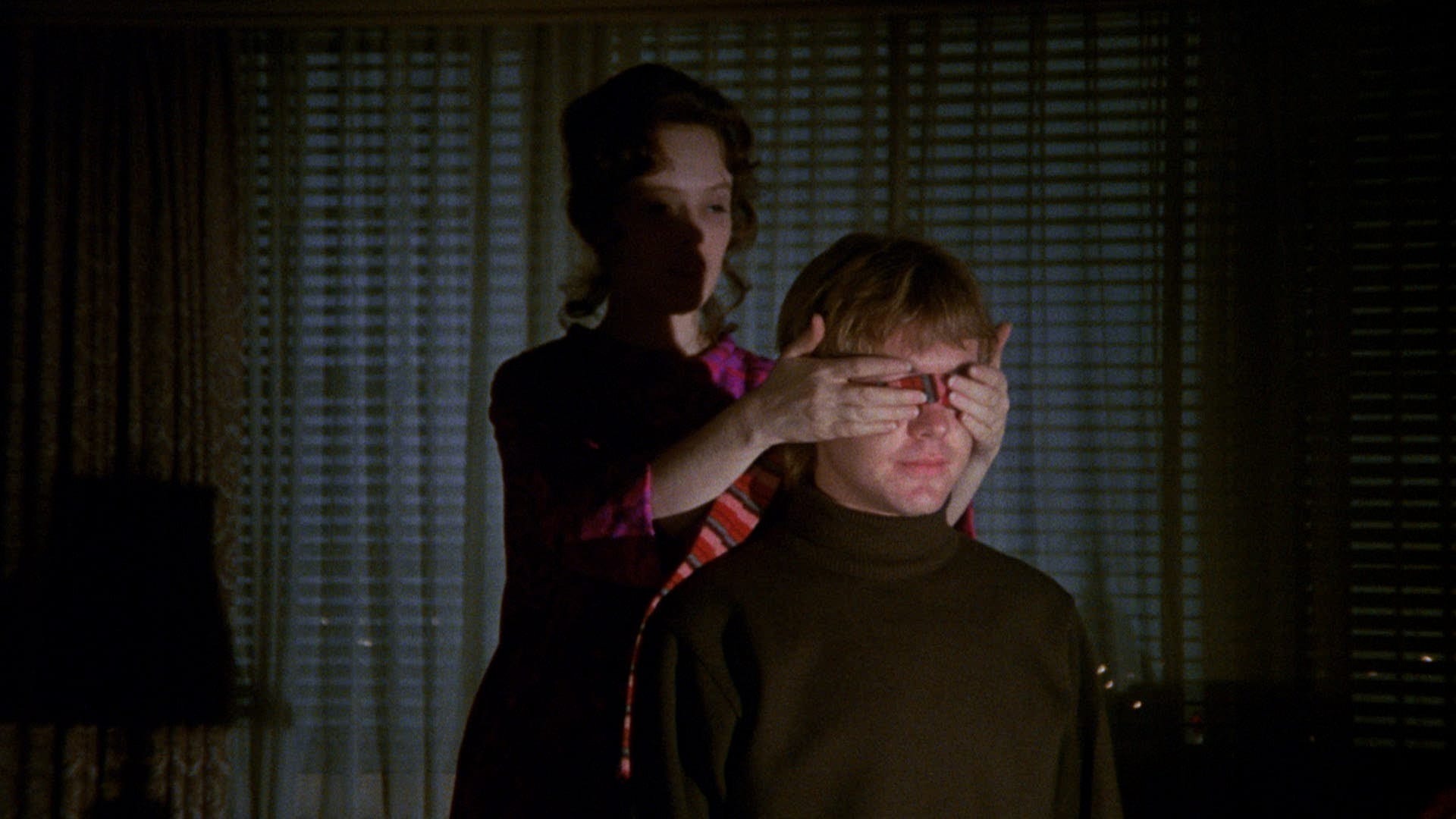
Altman’s film may be less unwholesomely gay than the novel, but it’s no less deliciously degenerate, featuring a cast of minor characters—pimps and lesbians, a hapless hooker, and the boy’s incest-minded sister—lending an almost Warholesque edge to the proceedings. It’s his first freely creative film, already featuring what would become his trademark techniques: overlapping dialogue, a meandering zoom lens (guided by master cinematographer László Kovács), and the use of mirrors and reflections to depict distorted, often female, psychopathology. That Cold Day in the Park premiered out of competition at Cannes and ended up a critical and financial flop upon its release. Altman would break through only a year later with MASH (1970), a box-office juggernaut that garnered him the Palme d’Or and five Oscar nominations. But I still prefer its predecessor by far!
Bruce LaBruce is a filmmaker, photographer, writer, and artist based in Toronto but working internationally. Along with numerous short films, he has written and directed fifteen feature films. His latest movie, The Visitor, was released in 2025.
Quintet (1979)
By Carlos Valladares
For still-baffling reasons, conventional wisdom has long dictated that Robert Altman’s Quintet is a failed experiment at best, among the gravest misfires in film history at worst. Wrong! Quintet is one of Altman’s most misunderstood, quaking, frightening masterpieces. Grieving the loss of his father in 1978 and his mother a few years earlier, Altman used the Star Wars money coming in to 20th Century Fox to eke out this cold-as-hell beast, a glacier-slow, oneiric, trance-inducing whatsit about humanity’s final days in a climate-changed Arctic tundra. With despondency, Altman stares annihilation in the eye—and chooses the potential of life, however tentative, cruel, and invisible it seems in a desolate landscape. Sadly, its star Paul Newman, as well as most critics who initially watched Quintet, rejected this mammoth achievement—all except Altman himself, who defended it to his dying breath. As well he should have.
The plot follows seal hunter Essex (Newman) and his pregnant wife, Vivia (Brigitte Fossey), as they make their way back to Essex’s birthplace (IRL location: the abandoned, frozen-over remnants of the Expo 67 world’s fair on the outskirts of Montreal). Here, dogs feast on the remains of emaciated corpses, and survivors mindlessly play an inscrutable board game called Quintet. In a high-stakes version presided over by a sinister hotel owner and gambler (Fernando Rey), players must kill both their opponents’ pieces and the opponents themselves. Essex and Vivia must try to outsmart their competitors and survive—for what purpose?
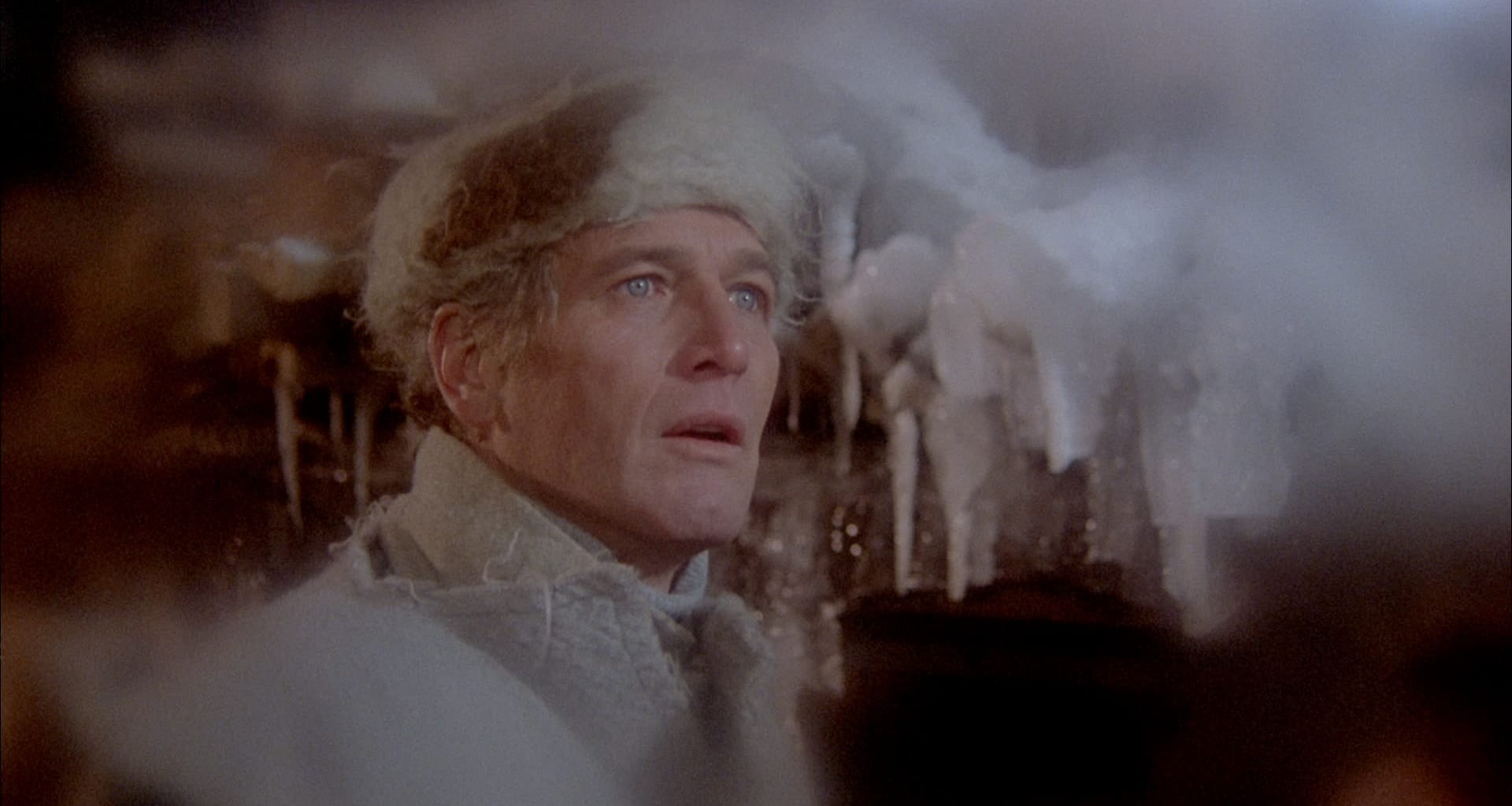
Quintet is a brilliant negation of all the vivid, palpably human ensemble dynamics present in Altman’s 1970s work. A woman burns her hand over a fire and doesn’t flinch. The man playing Paul Newman’s brother greets his character as if Essex were some alien stranger. Later, the brother explains to Vivia that he collects Quintet pieces as a hobby; Vivia, confused, asks him what a hobby is (language has been dying, too), and the brother responds: “That’s just something you do, for no reason.” Jean Boffety, the cinematographer, applies a weird Vaseline-like frosting to the edges of the lens, rendering this postapocalyptic Montreal in blurry soft focus, as if the viewer was going blind. All the while, in a send-up of that old humanist-capitalist homily that “we are all one,” photographs from an Ed Steichen–ish “Man and His World” exhibit—a Vietnamese peasant girl, a scowling Senegalese boy—peer down upon the Quintet players in eerie kitsch judgement. Wild, cacophonic themes composed by Tom Pierson play over each other, replacing Altman’s classic overlapping dialogue.
If this fearless exploration of how nihilism, inaction, and lovelessness threaten the human condition—and how they can be resisted—had been released fifty years later, and made by an Apichatpong Weerasethakul or a Guy Maddin, it would have been hailed as fresh and innovative. Like the best of Andy Warhol, it uses boredom as an aesthetic principle to pinpoint the depths of human loathing—both for the environment around us, and for each other.
Carlos Valladares is a writer, critic, curator, and film programmer. He studied film and art history at Stanford and Yale University. He has written for Gagosian Quarterly, Art in America, n+1, and the San Francisco Chronicle, among others. He is currently developing his first feature films, a political thriller and a romantic comedy, as well as an exhibition at the Marciano Art Foundation in Los Angeles on the poet John Giorno, slated to open in October 2025.
Prêt-à-Porter (1994)
By Christina Newland
It has a plot that staggers around more than Naomi Campell in Vivienne Westwood platforms. It features on-location runway shows during Paris Fashion Week, with backstage access and an ensemble cast that ranges from Julia Roberts to Anouk Aimée. Somehow, amid it all, Sophia Loren restages her notorious Yesterday, Today and Tomorrow (1963) striptease for Marcello Mastroianni thirty years on. And it features an inexplicable running gag about stepping in dog excrement.
Suffice it to say, even for a fashion-savvy viewer, Robert Altman’s Prêt-à-Porter is not a neatly explicable experience. It was detested by critics, having had the misfortune of arriving after two of Altman’s finest films of the decade: The Player (1992) and Short Cuts (1993). Maligned as it was for not having enough focus nor depth to truly leave an impression, this is a film that doesn’t so much claim to get fashion as it does simply luxuriate in the anarchic, glamorous, relentlessly empty force field that the industry emits. Altman seems genuinely curious about the designers like Issey Miyake and Thierry Mugler (his clothes are “all about getting a great fuck, honey”) who make cameos. These modish provocateurs of the ’90s broke with the stuffy elitism of old-school fashion houses, and the film takes note of who’s moving the needle in the art of fashion. Yet the showbiz machine that surrounds the art form is grotesque: full of backstabbing, bitching, and sexual assault.
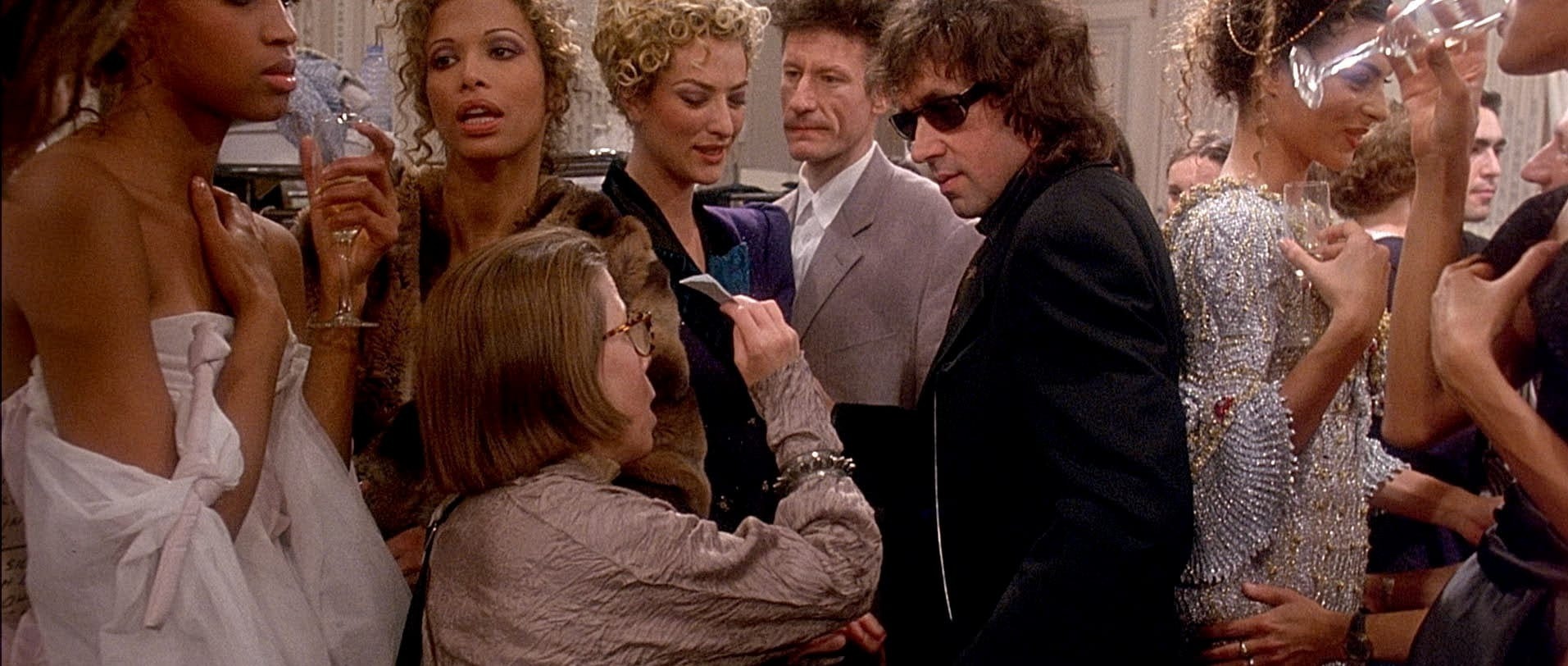
Kim Basinger brings a plucky energy as the clueless, Southern-accented fashion reporter and master of ceremonies who takes us through the latest discourse around Paris Fashion Week—she sounds like she’s repeating learned sound bites. Other vignettes are
Prêt-à-Porter is a strange, satirical, flimsy-as-hell, and somehow wondrous film about the fashion world. Maybe that’s what’s so appealing about its relentlessly surface-oriented subject: form follows content. When Aimée’s betrayed designer decides to make a statement and send her runway models out stark naked, the audience applauds sycophantically. We see how much the industry cares about its art form. This sickly superficiality—the film’s very flimsiness—is precisely the point.
Christina Newland is the lead film critic at the i newspaper and a contributing editor at Empire. She has written on film, pop culture, and boxing for Vice, Sight and Sound, the BBC, MUBI’s Notebook, and Reverse Shot, among other publications. Her forthcoming book, Sofia Coppola, will be published by Quercus in November 2025.
Popeye (1980)
By Howard Hampton
Five views of Robert Altman’s Popeye:
Popeye as laboratory: If you can manage to watch it without preconceptions—of what a Robert Altman film is supposed to be, how a musical is supposed to behave, how a big commercial gambit is meant to ingratiate itself—it unfolds like a research-and-development project testing Applied Eccentricity. Altman and his collaborators designed a methodical, off-the-cuff aesthetic that isn’t tethered to a specific time period or modus operandi. Everything is mix-and-not-quite-match, the loopy semaphore gestures choreographed to look like happy accidents. Sweethaven’s populace doesn’t arrive from any given comic-strip, cartoon, slapstick, or theatrical predecessor; they’re castaways who washed up at a Paramount backlot rummage sale and set up housekeeping.
Popeye as avatar of bespoke world-building: Erecting this slanted, tumbledown village on the side of a rocky seaside cliff in Malta, it anticipates the oddities of Paul Reubens, Terry Gilliam (you could see Time Bandits or Brazil as baroque amplifications of all things quixotic about Popeye), and Yorgos Lanthimos (Shelley Duvall’s Olive Oyl presents as asexual, but she and Emma Stone’s Bella in Poor Things are secret comedic sisters: gangling innocents run amok).
Popeye as prequel to The Player (1992): Teaming the combative Altman with arch-egotistical producer Robert Evans and uncompromising writer Jules Feiffer sounds like the setup to a Hollywood inside joke. You know: three control freaks walk into a bar . . . Evans wanted to make a film of the Broadway smash Annie but was beaten out for the rights, so he switched to another old comic-strip property. He roped in Feiffer, then rolled the dice on Altman (coming off multiple flops) and movie debutant Robin Williams as the titular mutterer. A recipe for disaster, and the movie was treated as such, but against all odds and cross-purposes, they found an irreverent synergy, banding together against the studio. (Despite its reputation as a bomb, it grossed between $50 and $60 million.)
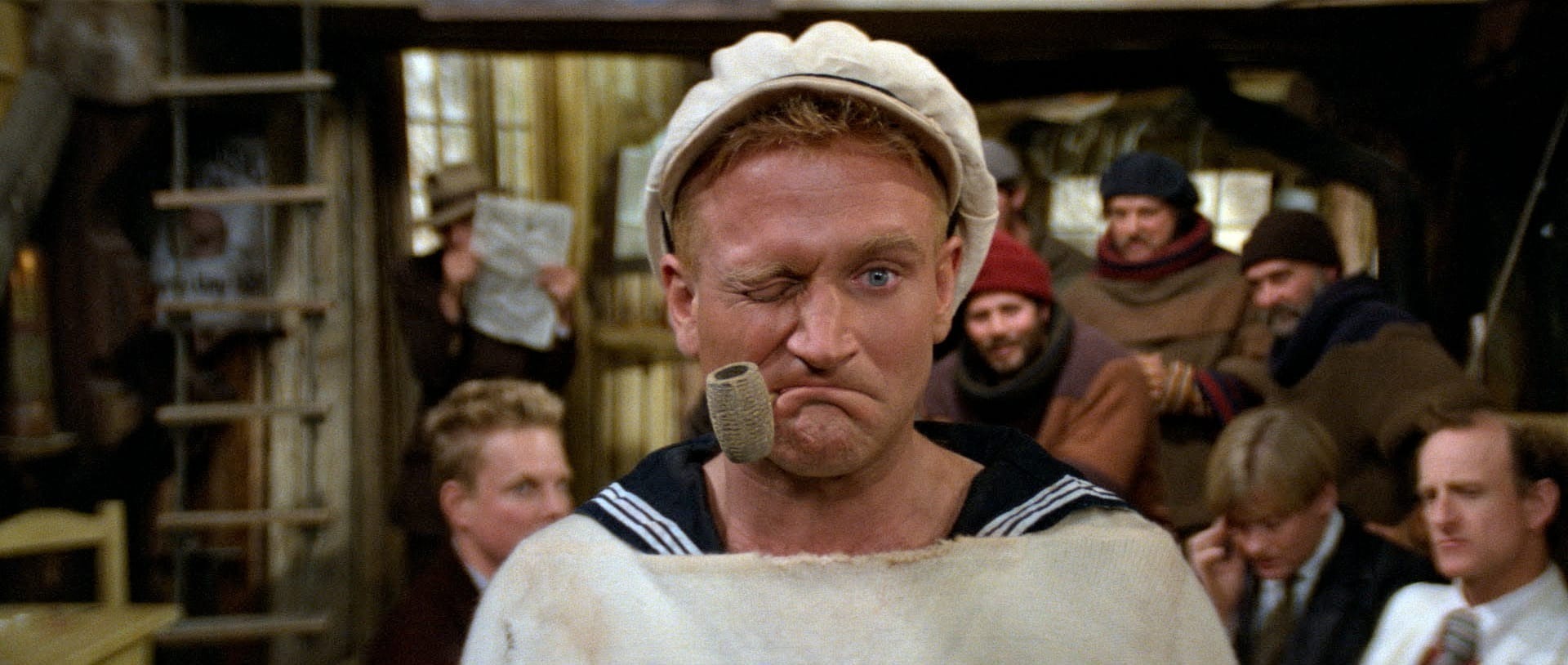
Popeye as party central: Six months on the dullest island in the Mediterranean, endless production delays from bad weather, stir-craziness galore. Kathryn Reed Altman: “Everyone was very loaded.” Massive alcohol consumption was paired with weed and later cocaine; the illicit substances were brought in concealed inside props, lifesize dummies, and film cans. It certainly seeped into the film’s ambiance.
Popeye as rogues’ gallery/music hall: Wobbling from background to foreground, a shaky parade of visages that belong on wanted posters or as caricatures on bathroom stalls, owning reedy voices that can barely lift a tune, let alone carry it. The faces are elongated, craggy, pinched, glowering, moon-cratered. There’s the anarchist-mug Richard Libertini; human hamburger Paul Dooley; Robin Williams, a scrunched-up munchkin on steroids; and peerless Shelley Duvall, who was justly called a female Buster Keaton here (but from a few fleeting angles looks like a Giacometti Garbo). The music by Harry Nilsson and arrangements by Van Dyke Parks evoke a Fellini circus banished to Davenport, Iowa. The most surprising casting and musical fact: Tom Waits isn’t in it.
Howard Hampton has written for Film Comment, Artforum, and many other publications. He is the author of Born in Flames: Termite Dreams, Dialectical Fairy Tales, and Pop Apocalypses.
Come Back to the 5 & Dime Jimmy Dean, Jimmy Dean (1982)
By Violet Lucca
By Violet Lucca
Altman’s decision to pluck Ed Graczyk’s Come Back to the 5 & Dime Jimmy Dean, Jimmy Dean from the obscurity of regional theater—putting it on Broadway with an all-star cast, then adapting it to the screen—parallels the play’s central fantasy. In 1955, a group of high schoolers who live in smaller-than-small-town Texas make a pilgrimage to the set of Giant in Marfa to see their idol. In true melodramatic teenage style, they’ve dubbed themselves “The Disciples of James Dean” and have matching red silk jackets. Twenty years later, they reconvene on the anniversary of Dean’s death to mourn and catch up.
Both the past and the present are shown to be run down, cluttered, and too painful to fully inhabit—not places you’d like to linger. And yet, here we are, locked with the Disciples in the dingiest Woolworths imaginable, where scenes from 1955 and ’75 unfold with so few distinguishing cues that it can be difficult to tell when some are taking place. (The store’s fundamental unpleasantness is also heightened by the film grain—Super 16 blown up to 35 mm.) Not unlike the five-and-dime’s owner pouring unfinished orange soda back into the fountain, all the actors (save for one notable exception) play their characters at both ages, allowing us to see the cruel absurdity of their lives: busty Sissy (Cher) is still making the same dumb jokes she did as a teenager while standing behind the same dumb counter.
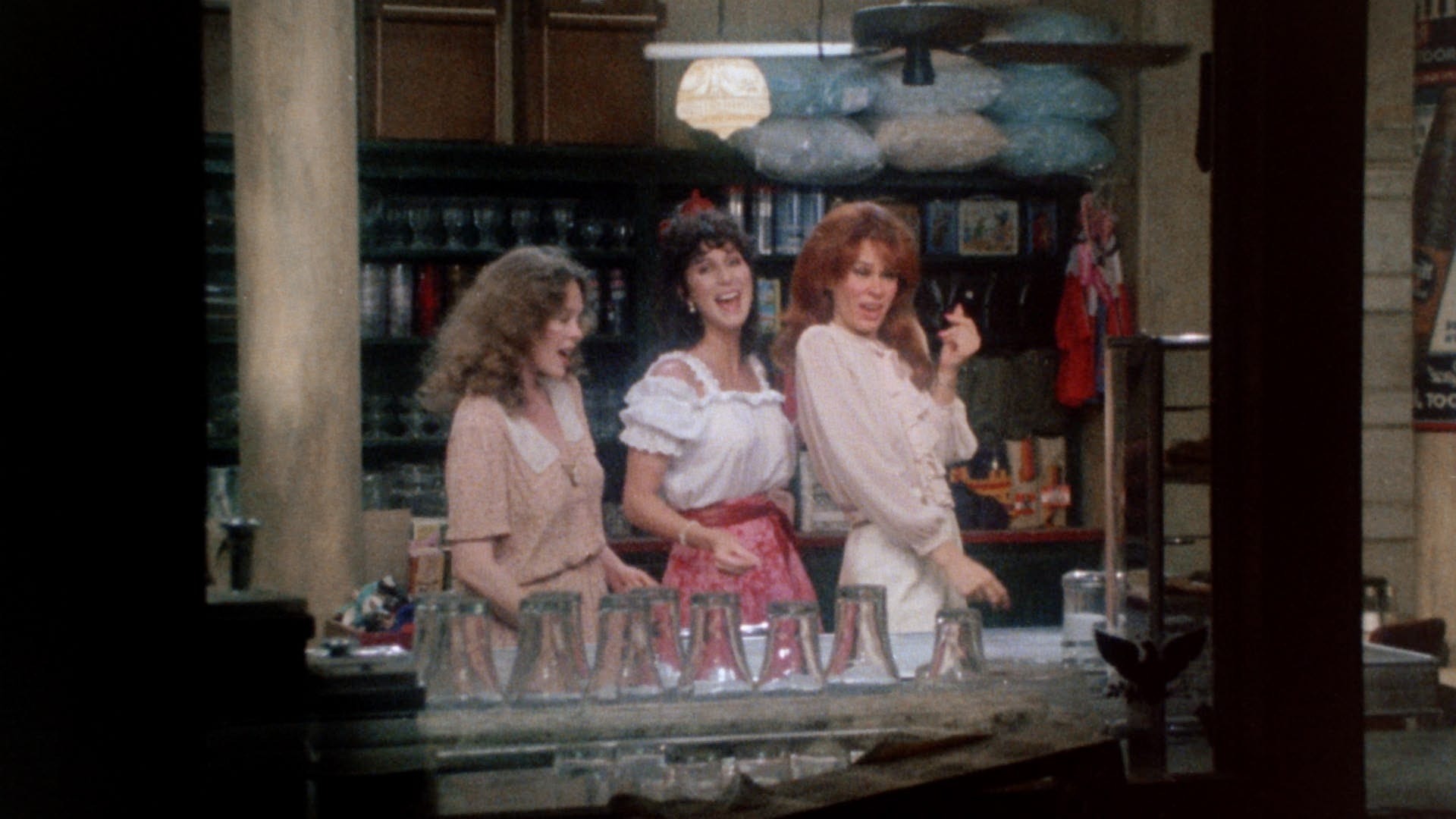
Altman (not Graczyk) makes clear Joanne (played by Mark Patton and Karen Black) is the only one who’s changed, not just physically but emotionally. Joanne transitioned after leaving this dying town, and comes out to her friends by pulling up to the Woolworths in a yellow sportscar and conspicuously browsing the store before announcing she was once the poor kid in overalls they knew. Everyone is supportive or outright wowed, save for the elderly, hateful Christian owner—plus ça change. Black—who said she struggled to find the character (an acknowledgement of the limitations of a cis actor playing a trans role) and spent time with a trans woman who showed her “how to move”—brings a depth to the role that’s made all the more painful by the shallowness around her. She hasn’t just “survived;” she’s done something far rarer and more miraculous.
Joanne loves her friends enough to let them tell the same old stories she’s heard a thousand times. Her friends love her too, and accept her for who she is in 1955 and in 1975. They don’t seem, however, to fully grasp the things that hurt her so deeply: though as a teen, Sissy is the first to wipe blood from Joanne’s mouth after she’s brutally beaten, Sissy goes on to marry the fucker who did it. Joanne’s ability to be polite slowly wears down: the more she hears and remembers, the more she drinks. She can’t pull them away from the lies they tell themselves.
While so much of the film is laden with symbols—oppressive heat representing the town’s stultifying social atmosphere, the broken hunks of the Giant house standing in for one Disciple’s crumbling fantasy world—one of the most damning is the offscreen “son of James Dean,” the town’s dubious claim to fame, who steals Joanne’s car and goes for a joy ride. Is he speeding toward a fiery wreck like the actor, or away from the past he’s been forced to live in? Though the last exchange we see between Sissy and Joanne is joyful, the final moments of Jimmy Dean show the five-and-dime empty and cobwebbed and silent as a tomb, a scene that seems borrowed from a horror film. Nostalgia, Altman shows, will bury you alive; it’s not all Happy Days.
More: Features
Small Town, Big Money: Capitalism Runs Amok in Turumba
In Kidlat Tahimik’s playful and unpredictable film, a Philippine village is tasked with manufacturing thousands of figurines for the Olympic Games, upending the lives and customs of the local population.

The Sudanese Film Group’s Legacy of Political Resistance and Creative Liberation
The members of this influential leftist collective created a formally adventurous body of work that examined the nation’s tumultuous history through a postcolonial lens.
Get Me Out of Here: Harry Dean Stanton in Straight Time
In one of his greatest performances, the celebrated actor shows off his range by fusing the two modes that defined his career: the misanthropic provocateur and the soulful survivor-witness.
Věra Chytilová’s Boldly Antiauthoritarian Take on Teen Horror
A characteristically rebellious work from the Czechoslovak New Wave pioneer, Wolf’s Hole explores the perilous absurdities of groupthink through the story of eleven youths held captive at a skiing retreat.