Without Irony
Share
From today through Sunday, the Chicago Film Society, founded by projectionists in 2011, presents its annual Technicolor Weekend at the Gene Siskel Film Center. “All of the films in this series will be projected from prints that were at one point or another saved by private collectors,” notes the CFS. “They were intended to last only through their initial runs, but instead have endured hundreds of screenings, studio mergers, film exchange closures, and multiple private owners.”
The series opens this evening with Alfred Hitchcock’s The Birds (1963), and along with Robert Clouse’s blaxploitation classic Black Belt Jones (1974) and Alan J. Pakula’s paranoid thriller The Parallax View (1974), the weekend will also offer Frank Tashlin’s The Disorderly Orderly (1964) with Jerry Lewis before wrapping on Sunday afternoon with Robert Stevenson’s immortal Mary Poppins (1964), starring Julie Andrews and Dick Van Dyke. As Jaime N. Christley once wrote of Mary Poppins for Slant, “Resistance is futile; the sugar is the medicine.”
This week’s highlights:
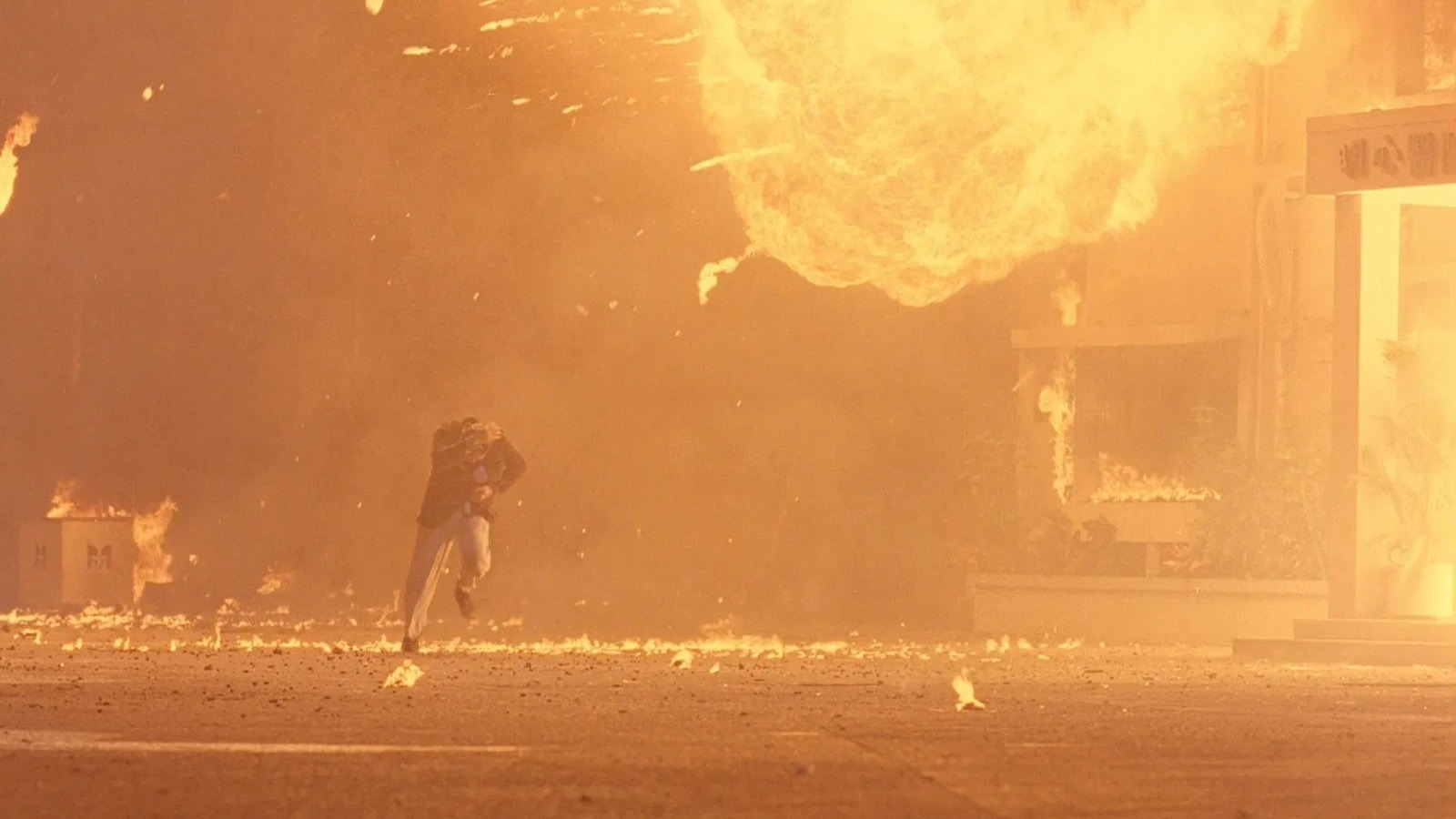
- Back in January, Variety reported that Shout! Studios had acquired the Golden Princess movie library, “a treasure trove of 156 Hong Kong cinema classics that’s been MIA from Western markets for decades.” Now restorations of films by John Woo, Tsui Hark, Ringo Lam, and Ching Siu-tung are screening in New York and Los Angeles through the end of the month. “These films demonstrated an almost experimental approach to action, with creative camerawork, unorthodox editing, and unabashedly over-the-top emotions,” writes Vulture’s Bilge Ebiri, who talks with Woo and others about the revivals. “What makes Hard Boiled and The Killer so incredibly powerful aren’t just the actors’ badass poses and Woo’s slow-motion delivery of balletic gunplay and pyrotechnic mayhem, it’s the fact that the protagonists are so unabashedly heartfelt in all their tortured longings and loyalties.”
- IndieWire’s ’70s Week naturally kicked off on Monday with a ranked and annotated list of the hundred best films of the decade. Bob Fosse’s All That Jazz (1979) at #1 is immediately followed by Pier Paolo Pasolini’s Salò, or The 120 Days of Sodom (1975), the subject of conversations with John Waters and Bruce LaBruce. Other highlights of the week have included tributes to the late Roger Corman from Martin Scorsese, Joe Dante, and many others; Keith Carradine on working with Robert Altman; Lovia Gyarkye on African cinema; a salute to Meiko Kaji and Pam Grier; a conversation with Walter Hill (The Warriors); and much more.
- “The people who are willing to admit Roman Polanski’s greatness as a filmmaker invariably point to his earlier films—Knife in the Water, Repulsion, Rosemary’s Baby, Chinatown—as evidence,” writes Charles Taylor for Liberties. “In other words, the ones he made before he was charged for—and before he admitted to—the 1977 rape of thirteen-year-old Samantha Geimer. Maybe they feel that it’s okay to praise movies made before he admitted to being a monster. But to get at Polanski’s true claim to greatness, you have to confront the stubborn empathy and depth of the films he’s made over the last thirty years, the inexplicable paradox of a man whose work showed a deepened understanding of suffering after he had victimized someone else.”
- The exhibition Chantal Akerman. Travelling, now on the final leg of its tour, is on view in Lisbon through September 7. Writing for Texte zur Kunst, Rainer Bellenbaum suggests that the installation From the Other Side and its accompanying film, De l’autre coté, both from 2002, might be viewed “in relation to the two sides of her practice—that is, to the constant shift between documentary, fictional, or essayistic film dramaturgy on the one hand and allegorical artistic creation on the other. Moreover, changes in perspective define Akerman’s work as a whole and inform the artist’s most important concern: the representation of the lived experience of women, which this retrospective revolves around without explicitly focusing on it.”
- “For twenty-two months, Hollywood has had no unified voice on the aftermath of October 7,” writes Ben Schwartz in the Nation. “Forty-three years ago, another prominent director struggled with many of these same issues—the Austrian émigré Billy Wilder.” Schwartz does not attempt to extrapolate a position that Wilder, who died in 2002, might have taken in 2025, but his piece is an illuminating window onto the director’s later years and his struggle to find a project through which he could work out his complex relationships with both his home country and the founding and future direction of Israel.
Don’t miss out on your Daily briefing! Subscribe to the RSS feed.