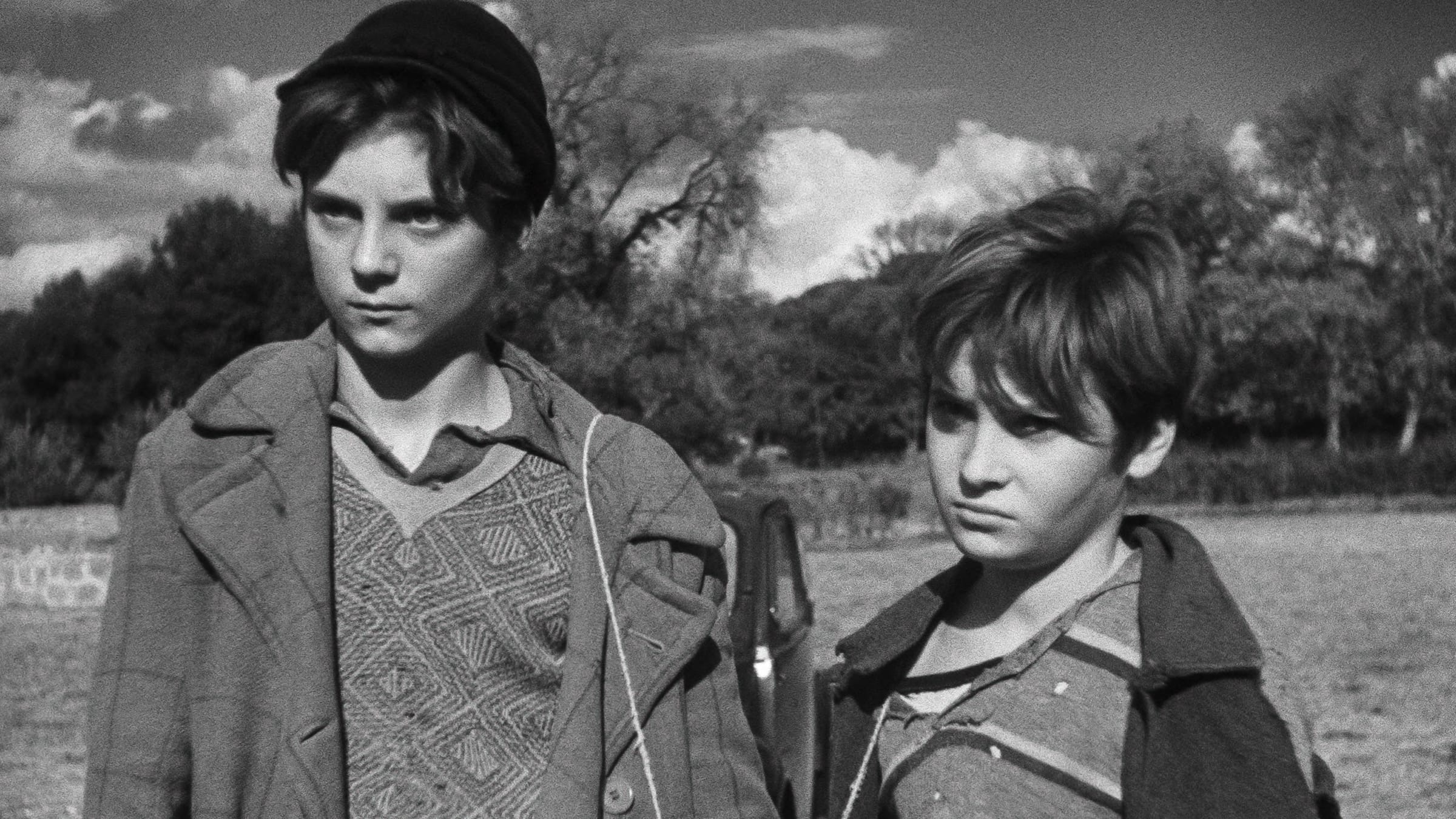
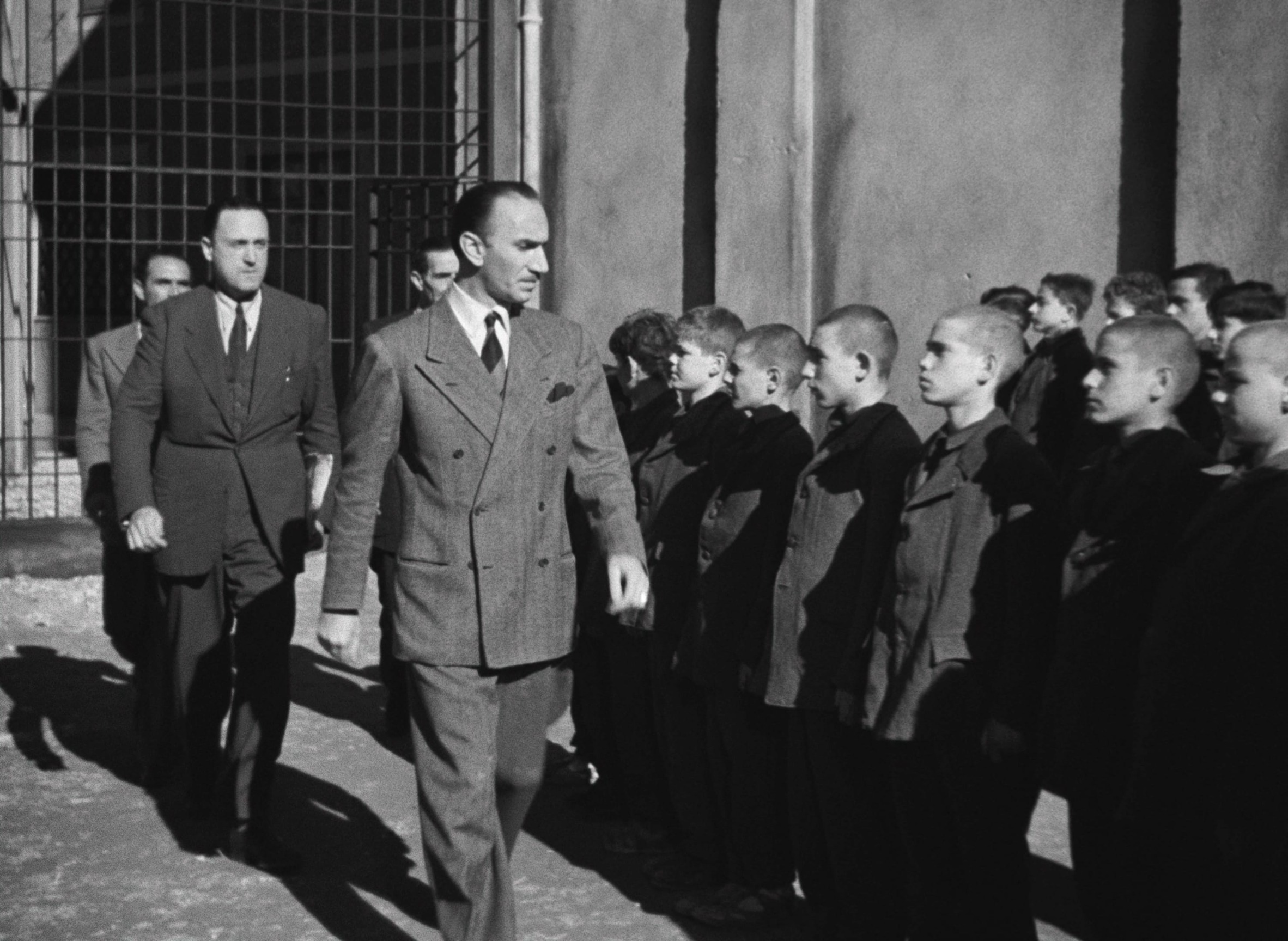
The film is remarkable for the way it stays centered on the children’s perspective on people and events and doesn’t stray from that into an adult moral framing. De Sica’s earlier film The Children Are Watching Us (1944) had also adopted a child’s view: a five-year-old boy sees his mother’s assignations with her lover and then witnesses the breakup of his parents’ marriage. In Shoeshine, similarly, we apprehend the adult world with Pasquale and Giuseppe, and even when they are not in shot, we receive their impressions of its indifference or hostility. Nearly all the adults are hard and uncaring, mere vehicles of their institutional roles, like Staffera and the prison governor (Mario Volpicelli), or greedy and selfish, like the fence Panza (Gino Saltamerenda) and his accomplice, Giuseppe’s older brother Attilio (Guido Gentili), who set the two young boys up as stooges for the theft and then make them swear they saw nothing to protect themselves from arrest. The few exceptions, like the kind liaison officer Bartoli (Antonio Nicotra), are too weak to challenge authority. He pleads with the boys to stay out of trouble and play by the rules, and in that way he, too, colludes with the system.
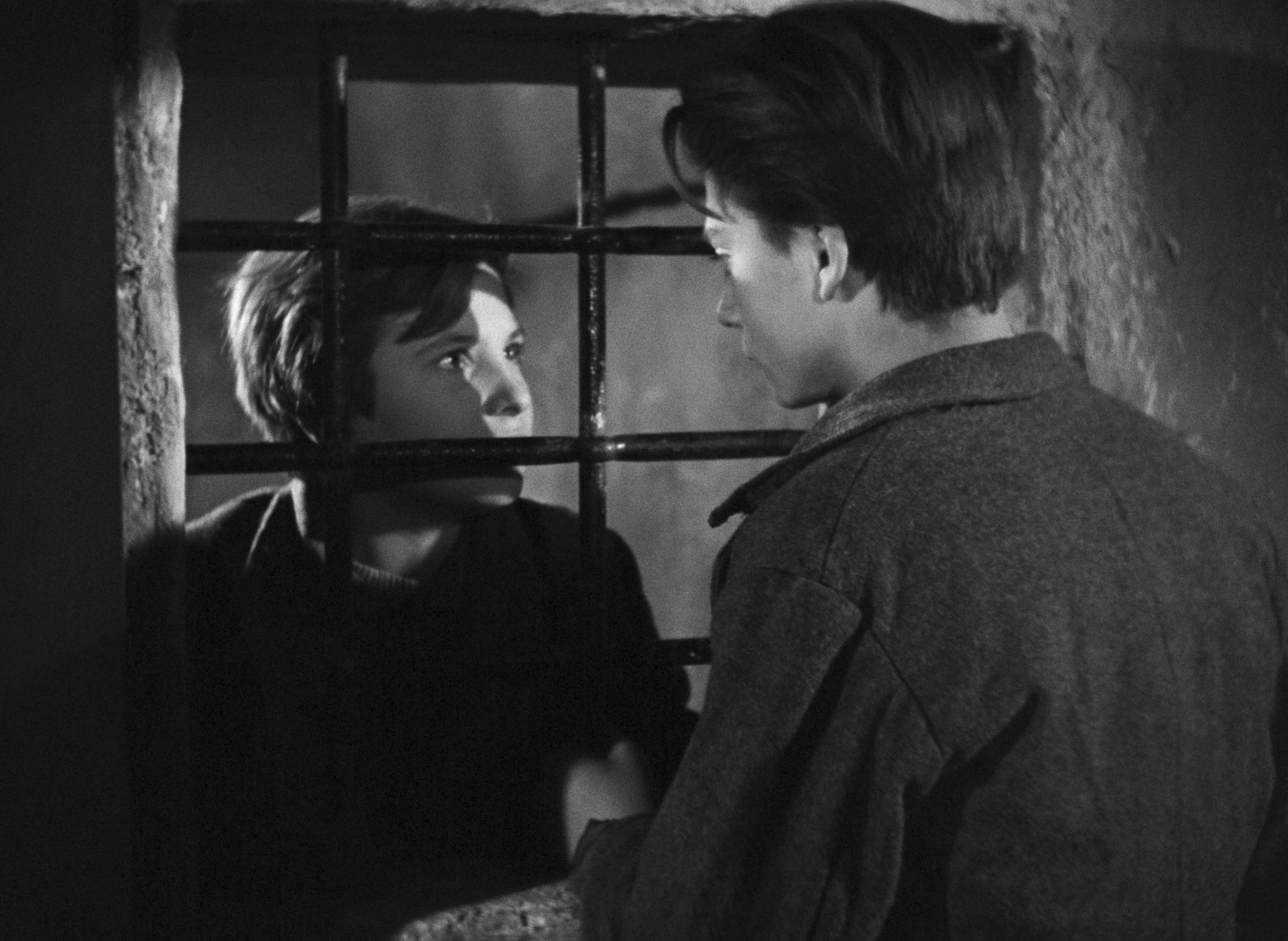
Some shots in Shoeshine have been fixed in my memory ever since I first saw it. One is the agonized expression of Pasquale when he believes he hears Giuseppe being beaten with a strap in an adjoining room. We are shown what Pasquale does not see—that the beating of his friend is faked, that another child is pretending to take the blows while Giuseppe has been taken out of the room—but that does not make Pasquale’s suffering any less real. Another indelible image is that of Pasquale’s face, again, this time full of terror, as Staffera removes his belt to beat him in his cell for something he did not do. The powerful effect of these scenes on me, I realize, is partly to do with memories of my own childhood that they trigger. I grew up in a much more comfortable home environment than the shoeshine boys in the film, but in the all-boys junior school that I attended in London in the late fifties and early sixties, corporal punishment was standard practice. I still remember the pain and humiliation of being caned—usually for “bad conduct”—and how I would hide afterward in the school toilets while my tears dried so my classmates would see me return defiant and not as “a baby.” It is very likely that De Sica as well as the writers who worked on the screenplay—Sergio Amidei, Adolfo Franci, Cesare Giulio Viola, and Zavattini—all had some experience of similar beatings as children.
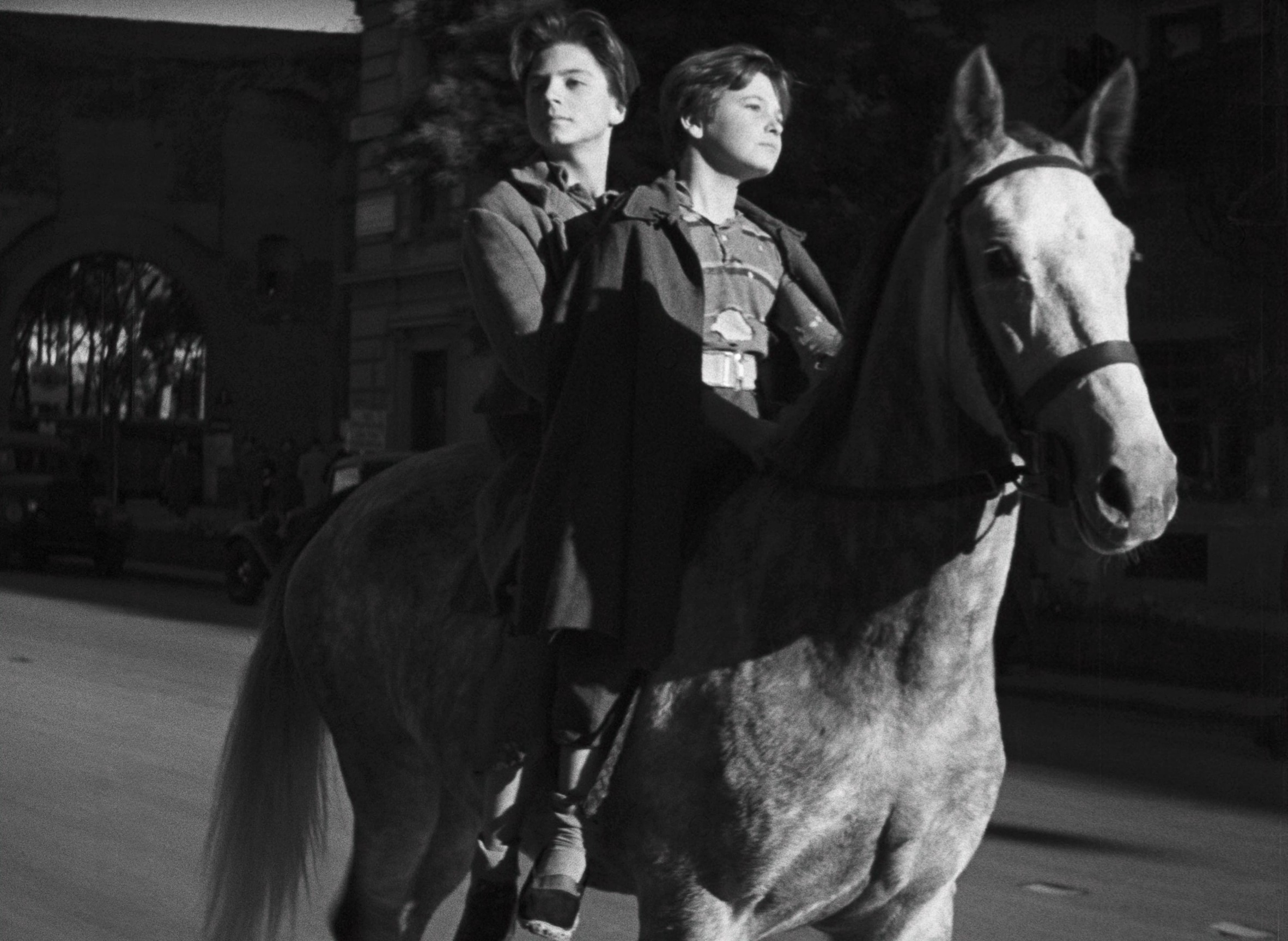
Those depictions of institutional violence and coercion, and of adult cruelty and indifference, are central to the film. There is also an implied political critique of the policing and carceral systems as continuations of the defeated Fascist regime, notably in the sequence with the prison governor, written by the Communist Amidei, who also wrote the part of the resistance leader Manfredi in Rome Open City. But for me, Shoeshine is also something more. It is a story about a friendship. It is about the unbreakable bond between two adolescent boys. Their friendship is a stronger tie than that of family. Giuseppe is content to leave his own family (who in any case are sharing overcrowded temporary housing with two other families displaced after bombing raids) and to sleep in the stable next to Pasquale, his orphaned friend, and near their horse. So strong is their friendship that it survives their separation in prison. Giuseppe refuses to let go of Pasquale’s hands when the latter is put in a separate cell, and they are later overjoyed when they are able to see each other again. Their bond survives even their mutual suspicions of betrayal and their jealousy at being supplanted. Giuseppe is taken under the wing of the manipulative Arcangeli (Bruno Ortenzi), and Pasquale looks after the sickly Raffaele (Aniello Mele). Both boys therefore reproduce with another their relationship with each other, but only in form: Giuseppe gets a new taller and older protector in Arcangeli, but the latter is purely self-interested. Pasquale becomes the protector of the younger Raffaele, but it is a temporary nurturing role, not a durable friendship.
The friendship between Pasquale and Giuseppe evokes other famous male friendships in the literary tradition that end with the death of one and the grief of the other. When Achilles laments Patroclus in The Iliad, he refuses all food, decides to join the battle, kills Hector, and drags his body behind his chariot to avenge his dead friend. In Montaigne’s essay on friendship, about Étienne de La Boétie, he says that their kind of friendship was superior to heterosexual love, since that rises and falls with the flames of passion whereas theirs was more constant and lasting. Shoeshine inherits this homosocial tradition—defined by an intense and quasi-erotic male bond—together with some of the misogyny that often goes along with it. The female characters are either passive spectators, like little Nannarella (Anna Pedoni), Giuseppe’s neighbor, who sees him off as he is taken away in the police van, and who cries in the courtroom when he receives his sentence, or go-betweens for someone else, like the woman who comes to the prison to tell, stiffly, the tearful Raffaele that his mother is out of town and cannot see him.