Leos Carax: Modern Loves
Share
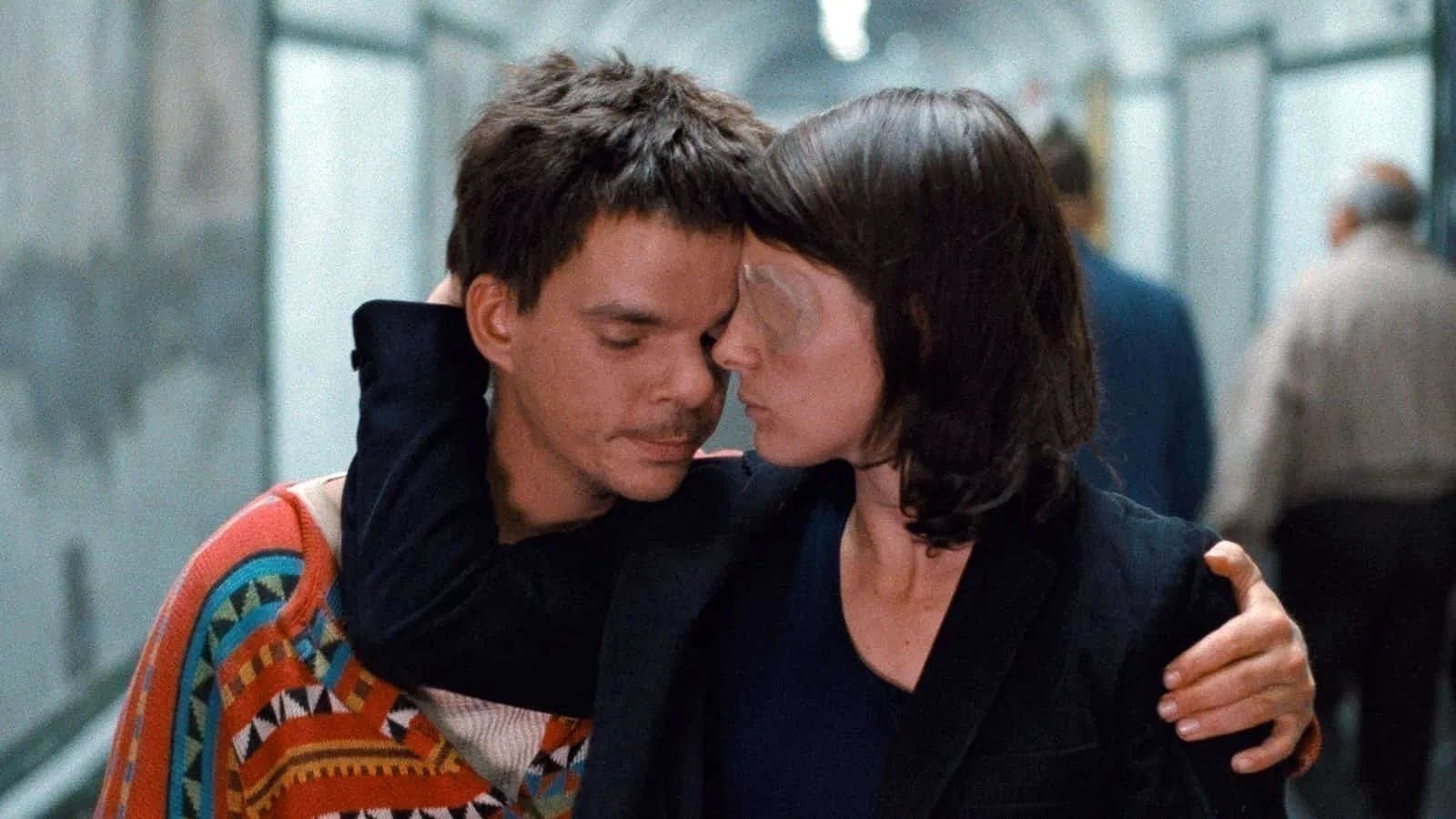
Before the new restoration of The Lovers on the Bridge (1991) opens on Friday, New York’s IFC Center is spending this week presenting Leos Carax: Modern Loves, a retrospective series of films that Beatrice Loayza, writing for the New York Times, has called “refreshingly outré, defiantly bombastic, and deliberately upsetting.” Then from August 15 through 31, the Austin Film Society will screen the Alex Trilogy, Carax’s first three features, all of them featuring Denis Lavant as the director’s boisterous alter ego.
Carax was twenty-three when he made Boy Meets Girl (1984), “and it hit the French cinema like a lightning bolt—sudden and electrifying,” wrote Calum Marsh in the Village Voice in 2014. That same year, Chuck Bowen observed in Slant that this debut feature is “in love with movies, and it conjures a movie world of inventively lo-fi density and dexterity.” Lavant’s Alex is an aspiring filmmaker who dreams up titles for films he hasn’t made, and as Bowen notes, he tells Mireille (Mireille Perrier), the suicidal young woman he’s drawn to, “that he never tried to fulfill his best dreams because he only wanted to re-dream them. That’s about as succinct, and empathetic, an encapsulation of youthful do-nothingness as any the movies have ever offered.”
Mauvais sang (1986) gives us probably Carax’s most famous sequence when Lavant—a former circus performer who trained at the Paris Conservatoire, the famed college of music and dance—hurls down a street with leaps and twirls in a driving and furious dance set to David Bowie’s “Modern Love.” Featuring Michel Piccoli as a gangster seeking to lure Alex into taking part in a heist, sixteen-year-old Julie Delpy as the girlfriend Alex sends away, and Juliette Binoche as the woman who’s caught his eye instead, Mauvais sang is, as Melissa Anderson has pointed out in the Voice, “nominally a neonoir set in Paris in the near future.” It’s “deeply in thrall to the masters of nouvelle vague, particularly Jean-Luc Godard. But Carax’s endlessly romantic film transcends homage (and plot, for that matter); above all, his work captures ineffable states of being.”
In a 2019 piece for Reverse Shot on Binoche’s “reckless, breakneck, once-in-a-lifetime performance” in The Lovers on the Bridge, Nick Pinkerton called the film “a story of love between two guttersnipes that has passages as convulsively romantic and as purely artificial as anything in the cinema of Frank Borzage.” Here, Alex is an alcoholic street performer breathing fire for passersby on the Pont Neuf, the oldest standing bridge in Paris, and falling for another vagrant, Binoche’s Michèle. One of them harbors a secret. “What a tangle of deceits is true love,” writes Pinkerton, and “what a remarkable collection of duplicities, this dead-earnest paean to amour fou.”
The Lovers on the Bridge was a notoriously difficult production with delays caused by—to make a very long story short—injury and cost overruns. The New York Film Festival hosted the U.S. premiere in 1992 but seven years passed before the film was theatrically released in the States. Stuart Klawans, the film critic for the Nation at the time and a NYFF selection committee member, was one of the film’s most vocal champions. “I’ve shown up in various cities for one-night screenings where, griotlike, I’ve sung the film’s genealogy and praise,” wrote Klawans in 1999. “I couldn’t back off even if Orson Welles were to descend from heaven and anathematize the picture, with Renoir at his right hand and Ozu at his left.” The strongest sequences in The Lovers on the Bridge are “pure essence of movie, the stuff that movies might have been invented to give us.”
Pola X (1999), loosely based on Herman Melville’s 1852 novel Pierre; or, The Ambiguities, is the single Carax feature left out of the IFC Center series. Writing in 2013 for the Los Angeles Review of Books about the many, many allusions he spotted in Mauvais sang, Charles Taylor noted in passing that Pola X is “stately and tormented, a film of great beauty and no joy. Seeing it now, it feels haunted by the ghosts of the actors who played its hounded lovers, Guillaume Depardieu, who died of pneumonia in 2008, and Yekaterina Golubeva, the Russian actress with whom Carax was raising a daughter and who died, reportedly by her own hand, in 2011.”
In Holy Motors (2012), Lavant’s Monsieur Oscar, chauffeured in a limo around Paris by Céline (Édith Scob), keeps a series of appointments to appear as radically varied characters. “On the surface,” wrote Leo Goldsmith in the Brooklyn Rail, “with its appearances by Eva Mendes and Kylie Minogue, singing a tune cowritten by the Divine Comedy’s Neil Hannon, it seems almost haphazard in comparison to Mauvais sang’s playful classicism, The Lovers on the Bridge’s Vigo-esque euphoria, or Pola X’s inexorable plunge from grandiosity to austerity. But in many ways, Carax’s new film is also curiously calculated and serene, especially in its final acts, when the extremities of its earlier scenes give way to a profound melancholy, a set of earnest rituals that reenact the scenes of death and regret.”
Starring Adam Driver as a standup comedian, Marion Cotillard as an opera singer, and an animatronic puppet as their daughter, Annette (2021), with its wall-to-wall soundtrack by Sparks, is what Nathan Lee, writing for Film Comment, called “a flamboyantly eccentric musical that both fulfills and obliterates the brief of its genre . . . At once fascinating and exhausting, Annette ceaselessly reflects on the nature of its own meta-commentary: a backstage musical about [Mulholland Dr.’s] Club Silencio filtered through the rhetorical sensibility of Southland Tales.”
It’s Not Me (2024) is a forty-two-minute response to a prompt from the Centre Pompidou, “Where are you at, Leos Carax?” When It’s Not Me premiered in Cannes last year, Eric Hynes, in conversation with fellow curator David Schwartz at Reverse Shot, declared that he loved it “more than I’ve loved anything here or elsewhere in a long time. A loving homage to his mentor Godard, a self-deprecating portrait of the artist at middle age, a scattershot skewering of the world’s many monsters, and an exquisitely, improbably harmonious pairing of somberness and vivacity, it also acts as a clever key to his entire oeuvre to date.”
Don’t miss out on your Daily briefing! Subscribe to the RSS feed.