Anthony Asquith

For too long languishing in Hitchcock’s burly shadow, Anthony Asquith was a charming maverick who emerged from one of Britain’s most patrician families—his father, the Earl of Oxford, had been Prime Minister, and his mother, Margot Asquith, was a celebrated socialite and aspiring writer. Film historians tend to regard Hitchcock as the only saving grace to have emerged from from the British silent period, but Asquith (or “Puffin,” as he liked everyone to call him), who also easily leapfrogged from silent to sound, has surely been underestimated, blessed with a self-effacing talent that could be applied to numerous genres.
A reluctant aristocrat, Asquith went to Oxford but then journeyed to Hollywood to study the film industry in the mid-1920s, staying with Douglas Fairbanks and Mary Pickford for three months in their palatial home. Immediately on his return to England, he cowrote the screenplay of Shooting Stars (1927), a satirical melodrama directed by A. V. Bramble. Puffin served as assistant director and also as editor. “One prided oneself at not needing a musical accompaniment,” he recalled in a conversation with me in 1963, “but we did a musical soundtrack because the film appeared just as sound was coming in.”
By 1929, his reputation as an adroit filmmaker was assured—based on two silent gems, Underground (1928) and The Runaway Princess (1929)—and in that year he directed his finest silent (well, almost) movie, A Cottage on Dartmoor (at that point, sound technique in Britain was still developing, and he could insert only a brief “talking” scene). The script was based on a story that had appeared in the Weekly Dispatch, about a barber who accidentally wounds his rival in love and is sentenced to prison on Dartmoor, in the southwest of England. “But except for the actual escape from the prison, we concocted the sequences ourselves,” said Puffin. “The last sequence is a sort of liebestod,” he said, referring to the hero’s death in the arms of his beloved, “edited in the style of Eisenstein and Pudovkin.”
This succès d’estime introduced the richest decade in Asquith’s career, including Tell England (1931), a harrowing description of the Gallipoli campaign in World War I; Dance Pretty Lady (1932); Unfinished Symphony (1934), a biopic about Schubert; and Moscow Nights (1934), starring Laurence Olivier and released in the U.S. as I Stand Condemned—a period that culminated with Pygmalion (1938), which Asquith codirected with star Leslie Howard. For his film version, the third already by that time, he made one major addition to the Bernard Shaw play. As he explained: “I wanted to include a scene of triumph at the ball. So I arranged a lunch with Bernard Shaw, and for some reason or another, Shaw liked my line ‘she came up the stairs with the frozen calm of a sleepwalker,’ and he wrote the scene for us.” Professor Higgins’s removing his hat in the final shot was a felicitous touch invented by Puffin, who also told me that he was proud of having written the line “In Hertford, Hereford, and Hampshire, hurricanes hardly happen.” In fact, he added, “My Fair Lady is really closer to the film than to the play.” Higgins was played by Howard, whom Puffin remembered as “a brilliant technician. He could repeat a shot half a dozen times and his eyebrow would be raised to exactly the same degree.”

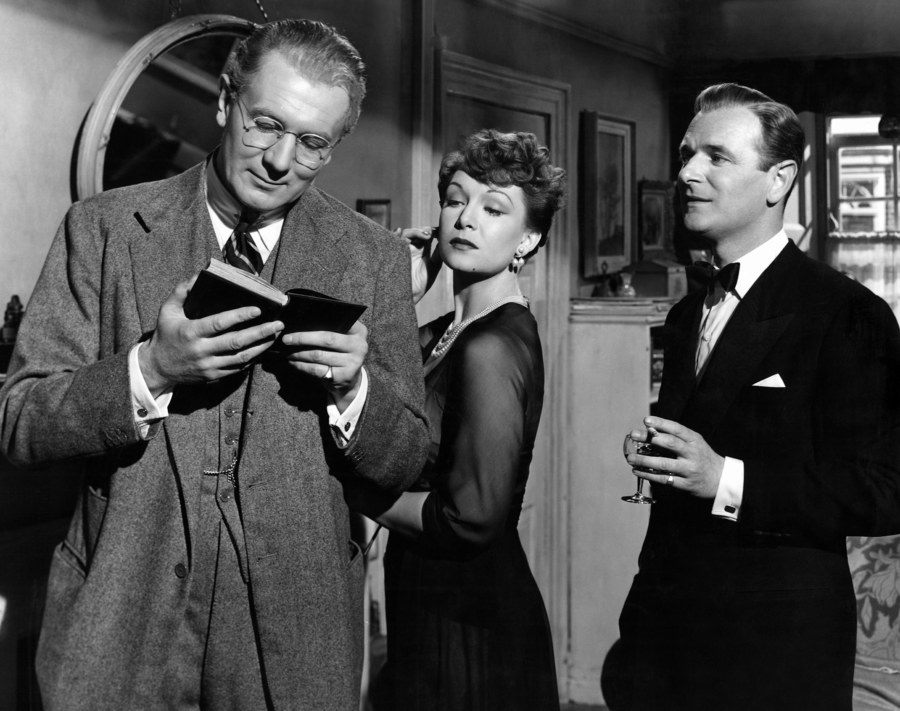
The Importance of Being Earnest (1952) proved to be Asquith’s greatest box-office success, and arguably the smartest screen adaptation of any Oscar Wilde play. “I insisted on ‘curtain up,’ ‘curtain down’ so as to preserve the stage conventions.” Who can forget Edith Evans as Lady Bracknell, her tone forever interrogatory, her comportment a regal passage of purple plumage across the drawing rooms of one fashionable house after another? “I remember we were told that the Americans didn’t know the word perambulator,” smiled Puffin. “And so we decided to say ‘baby-carriage’ instead. But Edith drew herself up and pronounced magnificently, ‘As a Dame of the British Empire, I protest against this!’ ”

Questions of personal honor suffuse Asquith’s war masterpiece Orders to Kill (1958). He had more to do with the creation of this film than any of his previous productions. “It started from my being told an anecdote on a sofa,” he recalled after we had viewed it together. “And then, with the invaluable help of George St. George, Paul Dehn and I wrote the script virtually from scratch.” Paul Massie plays an ex-pilot who, sent to Paris in 1944 to kill a traitor, is mentally ruined by the ordeal, becomes an alcoholic, and only returns to normal when he accepts that his is not such an individual guilt after all. “I suppose the two points that arise from the film,” maintained Asquith, “are that there is really no difference between dropping a bomb and killing an innocent man, that you’re just as likely to kill an innocent person with a bomb as you are with your hands.”
In early 1963, while Asquith was shooting The V.I.P.s at Borehamwood Studios in north London, the magazine Films and Filming commissioned me to write a profile of this most English of directors. Although scripted by the dependable Rattigan, The V.I.P.s did not sound promising. In many ways a predecessor to Airport , it groaned beneath the weight of stars like Elizabeth Taylor, Richard Burton, Louis Jourdan, and the ubiquitous Orson Welles (although Margaret Rutherford, to Puffin’s delight, won the Academy Award for best supporting actress). I visited the set, and Puffin grew excited at the prospect of such attention in a “serious” publication like Films and Filming . His leg in plaster due to cartilage problems, he deprecated his work on The V.I.P.s at every opportunity: “I didn’t work on this script,” or “One doesn’t feel that it’s quite one’s own child,” and “The difficulty of this production is that I’m constantly having to shoot round all sorts of characters.” He fretted over shooting in ’Scope: “It’s frightfully limiting—you can’t concentrate, and it’s much slower because your eye has time to wander.” To my surprise, he arranged for me to see almost all his important films on a succession of weekday mornings, in the tiny viewing theater at the top of the NFT on London’s South Bank. More often than not, he would attend. Like most critics, I dislike having to watch a film with the director sitting nearby, but Puffin was so self-effacing, so utterly lacking in arrogance, that my enjoyment of his work was enhanced by his presence.
When my survey of his career appeared in Films and Filming , Puffin sent me a charming letter. He was relieved that I had not slaughtered his efforts. “I don’t believe that anyone,” he wrote, “even if he entirely disagreed with your opinions, could fail to think it an admirably cogent and beautifully written presentation of the case for the defense.” Accompanied by an aristocratic woman whose name I have long forgotten, he treated me to lunch at the Hyde Park Hotel in Knightsbridge and gave me an elegant book on the history of ballooning, one of the few subjects Puffin himself had not essayed in his screen work. Only two tidbits of wisdom can be found in the notes I made afterward: “The point of a close-up is not that it’s ‘close,’ but that it isolates,” and “I’ve never been an actor, so I don’t have any temptation to instruct them!” Highly strung, seemingly frail, and almost too gentle to have survived in the film business across six decades, Puffin Asquith gave you the impression that he really needed your opinion of his work. Pretty rare for a film director.


